
1966-1967
TWO
VERY BIG
JOBS
BY THE PAN AM HISTORICAL FOUNDATION
THE FACTORY
&
THE AIRCRAFT
The largest factory in the world & the largest plane in the world.
In short order.
Sales of 747s to other airlines were developing at a rapid pace. There had been an out provided for Boeing if the company failed to sell enough 747s (including those going to Pan Am). But there was already too much riding on the deal to shut it down!
Even before the Boeing Board of Directors gave its final approval, Boeing had started the process of scouting for workers and acquiring land for a massive factory building.
Boeing Opens 10 Offices To Recruit Throughout Nation
"Ten permanent personnel recruiting offices have been established across the nation by The Boeing Company as part of an effort which will add more than 15,000 persons to Seattle area payrolls during the coming year...
Of the 15,000 new people, there are present openings for 4,000 professional and technical classifications alone. In addition, Boeing has urgent needs for machinists, tool and die makers, tool fabricators, assembly mechanics, inspectors, tool designers, tool and production planners, plus a wide variety of other skills."
"Boeing News," January, 1966 (Museum of Flight Archive).
1966
THE BUILDING
BEGINS
Boeing scouted potential locations and decided in June 1966 to acquire 780 acres adjacent to Paine Field, a former airbase in Everett, 30 miles north of Seattle. First order: clear away forest and scrub, then move over 4 million cubic yards of soil for a well-drained, flat surface—more earth-moving than the Panama Canal needed.
JULY 1966
BOEING CELEBRATES ITS 50th ANNIVERSARY
July 15, 1966, Juan Trippe arriving in Seattle to attend and speak at Boeing's 50th Anniversary festivities (Courtesy The Boeing Company Archive).
July 15, 1966, Juan Trippe arriving in Seattle to attend and speak at Boeing's 50th Anniversary festivities (Courtesy The Boeing Company Archive).
Bill Allen (5th from left), Juan Trippe (5th from right) and Mrs. Betty Trippe (center) at the Boeing banquet. From "William McPherson Allen (The Boeing Company), Boeing's 50th Anniversary Banquet, July 16, 1966" (Photo: Steven R. Shook Collection on Flickr).
Bill Allen (5th from left), Juan Trippe (5th from right) and Mrs. Betty Trippe (center) at the Boeing banquet. From "William McPherson Allen (The Boeing Company), Boeing's 50th Anniversary Banquet, July 16, 1966" (Photo: Steven R. Shook Collection on Flickr).
TRIPPE SPEAKS
THE 747 —
A BOLD, HUMAN VENTURE
"Great as was the contribution of the 707, the contribution of the 747 will be even greater. Far more important than its effect on fares and rates, however, will be its effect on human history. The new era of mass travel between nations may well prove more significant to human destiny than the atom bomb...
There can be no atom bomb potentially more powerful than the air tourist, charged with curiosity, enthusiasm and good will, who can roam the four corners of the world, meeting in friendship and understanding the people of other nations and races."
--Juan T. Trippe, Boeing 50th Anniversary Speech, "Speeches by Pan Am Executives, 1941-1960."
(University of Miami Special Collections, Pan American World Airways, Inc., records.)
At the Boeing 50th: Juan Trippe, Pan Am's Board Chairman (r) and Boeing President William Allen (center) with Crawford H. Greenewalt, Director and Chairman of the Board of the E. I. DuPont de Nemours Co. and a member of the Board of Directors of the Boeing Company (l). (Pan American Clipper, August 1966, University of Miami Special Collections).
At the Boeing 50th: Juan Trippe, Pan Am's Board Chairman (r) and Boeing President William Allen (center) with Crawford H. Greenewalt, Director and Chairman of the Board of the E. I. DuPont de Nemours Co. and a member of the Board of Directors of the Boeing Company (l). (Pan American Clipper, August 1966, University of Miami Special Collections).
THE PAN AM POLICY
Pan American World Airways already had deep experience bringing new airplanes into service. In 1968 a Pan Am brochure "Pan Am's Flying Clippers," the company detailed the unique history behind its aircraft designs:
“The 747 Superjet will mark another step in a well-established Pan Am policy — anticipating customers' needs. As the 747 story illustrates, this policy has meant participating from start to finish in the design and development of aircraft to meet these needs.
Over the years, it has required that Pan Am be the first to acquire these new aircraft...
◦ the Sikorsky S-40 — first commercial, 4-engine flying boat
◦ the Martin M-130 "China Clipper" that opened up transpacific travel
◦ the Boeing B-314 — last and largest of the great seaplanes
◦ the Boeing 377 Stratocruiser
◦ the Boeing 707
Soon — the 747's. And, due in the 1970's, even faster, supersonic jet transports — the SSTs. After that, who knows?”
Pan Am Superjet Illustration from a 1968 Brochure, "Pan Am Flying Clippers" p. 22 (University of Miami Special Collections).
Pan Am Superjet Illustration from a 1968 Brochure, "Pan Am Flying Clippers" p. 22 (University of Miami Special Collections).
A NEW PHASE OF JET AGE TRAVEL
The Superjet was an opportunity that never would have launched without the vision shared by the leaders of both Pan Am and Boeing, and the dedicated work of people in both companies who continued to work on refining the 747 specifications.
Pan Am had committed to spend $525 million for 25 aircraft – 23 passenger planes, with two more as dedicated freighters.
Built into Pan Am's deal were specific delivery dates that Boeing would need to meet in the coming months.
For Boeing it would be a complex task, but it would provide them with an airplane to sell to other carriers around the world who were facing the same challenges as Pan American.
Building the 747 would draw on new as well as time-tested engineering and technology.
BOEING GETS APPROVAL
On July 25th the Boeing Board of Directors approved spending that would amount to $2 billion for the 747 program.
Enter Joe Sutter
Read more about Joe Sutter's accomplishments. Photo: Sutter with Boeing's original 747, "The City of Everett." from The Joe Sutter Educational Fund, Boeing Department of Aeronautics and Astronautics, University of Washington. https://www.aa.washington.edu/giving/sutter
August 1966. Veteran Boeing engineer Joe Sutter who was working on the Boeing 737, got a call to head up a team designing Pan Am's big new jet.
By month's end, he'd pulled together a core group of 100. The 747’s design progressed in close collaboration with Pan Am. And once the widebody design was locked in, Sutter and his team engineered an airliner matching Pan Am's specs. It would have
1) A wing swept back at 37.5 degrees for fast, efficient cruise at Mach .85.
2) Four main landing gear posts spreading the load, and,
3) Abundant redundancy in systems that provided a new safety standard.
New Construction Site in Everett (Pan Am Historical Foundation Film Collection).
New Construction Site in Everett (Pan Am Historical Foundation Film Collection).
FACTORY CONCEPT
An illustration of the factory was published in "Boeing News" by creating an overlay of physical building models on to a photo of the land where the construction was taking place. The buildings would be used as follows:
"The central structure to be used for major manufacturing and final assembly of the 747 airplane, is flanked by a manufacturing building which will contain the production mockups of the airplane, and a building to be used for cleaning, painting and sealing of the airplane components. Also shown are (at the left) an office building and cafeteria and (extreme right) a warehouse and a plant services building."
"Boeing News," August 4, 1966.
THE BIGGEST BUILDING EVER
Images from The Pan Am Historical Foundation Film Collection
Clearing the land for Everett Factory construction (Pan Am Historical Foundation Film Collection).
Clearing the land for Everett Factory construction (Pan Am Historical Foundation Film Collection).
Building the factory frame at Everett (Pan Am Historical Foundation Film Collection).
Building the factory frame at Everett (Pan Am Historical Foundation Film Collection).
Working on factory construction, Boeing's Everett Plant (Pan Am Historical Foundation Film Collection).
Working on factory construction, Boeing's Everett Plant (Pan Am Historical Foundation Film Collection).
The Everett Factory construction makes progress (Pan Am Historical Foundation Film Collection).
The Everett Factory construction makes progress (Pan Am Historical Foundation Film Collection).
CONSTRUCTING
A RAILROAD
FOR
THE FACTORY
THE NEW RAIL LINE
"The line is only two miles long, but it contains one 13 degree curve, two of ten degrees and a host of others ranging from two to seven degrees. None of these figures is unusual, until one learns that during that two mile run, the spur will rise 537 feet--a grade of 5.6%, or double that considered economically feasible for railroad main line operations.
While the cost of this spur line has been large, it is minor when compared with the overall costs involved in making the Everett site an operational unit. Without the spur line, 747 bits and pieces would have to be trucked in. And some of those "bits and pieces" are so large that there are no suitable trucks available, nor roadways large enough to carry them. So, the spur line was built."
Boeing "Jet Lines," November 1966 (Museum of Flight Archive).
In winter 1966, Boeing employees christened the new 30-ton diesel locomotive to transport steel, roofing materials, tons of wire and circuits along with siding and other supplies. It would pull the supplies on flat cars up a grade on a track 5/8 mile, from Renton's main train lines to the construction site.
The engine, "Little Toot," was painted white with the name "The Boeing and Lake Washington Railroad" in red. It would reduce the need for warehousing supplies. Hopefully it would also allow more space for workers and factory activities by replacing transport trucks that could take up space and amplify traffic and parking problems around the site.
Laying down the tracks for "The Boeing and Lake Washington Railroad" at the Everett Factory.
Laying down the tracks for "The Boeing and Lake Washington Railroad" at the Everett Factory.
The Railroad Delivers
In 1967 efforts had been largely focused on construction and completion of the buildings and equipment. At that time, 747 parts were already being created by subcontractors around the country.
By 1968 components and structural sections of the new aircraft started arriving at the Boeing factory in railroad cars built specifically for that purpose. These shipments marked the beginning of a highly coordinated production effort.
The project quickly reached its first major milestone: The official completion and approval of the Class III 747 mockup. It was a full-scale model of the plane, meant to facilitate manufacturing, carefully inspected and certified by Boeing engineering and quality assurance teams, and also by representatives from Pan Am working at the Boeing plant.
After getting approval, Boeing shifted the 747 project into high gear, launching a full-scale production of what would soon become one of the most iconic airplanes in history.
Recap from "Everett Bulletin," 1969 (Museum of Flight Archive).
Team meets in Railroad Car, "Boeing News," September 14, 1967 (Museum of Flight Archive).
Team meets in Railroad Car, "Boeing News," September 14, 1967 (Museum of Flight Archive).
THE COMPLEX AT EVERETT
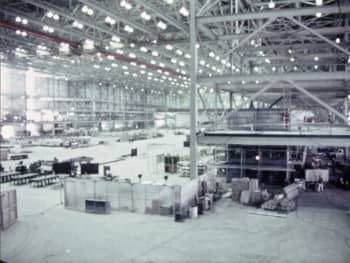
The massive factory complex would be 115 feet high, enclosing more than 160 million cubic feet. The main bay was 1,150 by 1,000 feet—providing 1.36 million square feet for final assembly.
Frames of Interior of the Everett Factory being constructed (Pan Am Historical Foundation Film Collection).
Frames of Interior of the Everett Factory being constructed (Pan Am Historical Foundation Film Collection).
A Work-Around
The original factory completion date was set for September 1967, but work would commence on aircraft production in the still-unfinished factory.
Actual completion of the site was not until shortly before the 747's public roll-out in September 1968!
Frames of Interior of the Everett Factory being constructed (Pan Am Historical Foundation Film Collection).
Frames of Interior of the Everett Factory being constructed (Pan Am Historical Foundation Film Collection).
Components
With the magnitude of the job of building 747s in an unfinished factory, Boeing would bring about 65% of the 747's components from offsite facilities and subcontractors nationwide.
Frames of Interior of the Everett Factory being constructed (Pan Am Historical Foundation Film Collection).
Frames of Interior of the Everett Factory being constructed (Pan Am Historical Foundation Film Collection).
The Auburn Plant
“At Auburn, work is well along in the development of a 260 acre central fabrication plant. Fourteen structures are going up at Auburn, ranging from small support buildings to a large spar and skin mill building, now being occupied. Facilities engineers report that the entire project is about 70% complete.”
September 1966, "Jet Lines," p. 2 (Museum of Flight Archives).
INITIAL WORK BEGINS ON THE 747
1966 - 1967
Engineering developed interior and exterior designs.
Boeing's Wichita Division began producing Superjet parts.
Subcontractors delivered.
Well into the first year, design problems cropped up. For instance, the original wing design, after wind-tunnel testing, proved to have structural anomalies that might compromise the entire wing design. Fortunately, a relatively simple fix solved the problem.
RENTON
Even before July 1966, with the formal approval of the factory at Everett along with the plane, there had been a lot of preliminary activity at Boeing's Renton plant to prepare for the 747.
March 1966. Minor assembly work began.
April 1966. 12,000 visitors visited the site on Family Engineering Day.
May 1966. Initial occupancy of the major and final assembly area occurred. Production also started in the manufacturing area as employees began installing 747 wing panel jigs.
July 1966. First production parts from the Seattle area were finished and ready for assembly.
EXPLORE MORE PAN AM HISTORY !
JOIN US !
 Built with Shorthand