
SUPERJET
CHALLENGES
BY THE PAN AM HISTORICAL FOUNDATION
WORKING OUT THE PROBLEMS
"Number four [Pan Am}, already a veteran of two hours and two minutes of flight, was at Everett while Pratt & Whitney personnel installed stronger engine shafts in the pre-production engines used in the initial phase of the 747 flight test program."
“747 Build Up” Everett Bulletin, May 23, 1969.
Pratt & Whitney
JT9D's
Boeing had an obligation to deliver the 747 that would fly with the specifications legally established in the contract with Pan Am. Trippe, on the other hand, wanted the planes to premiere before any other airline.
But the late delivery of engines from Pratt & Whitney delayed Boeing's delivery of 747s to Pan Am into the first weeks of 1970.
"As a corollary to growth of the airplane was a need for growth in engine thrust. The JT9 was a totally new engine the first ever designed directly for a new commercial airplane. It was on the same tight development schedule as the airplane, but now a level of take-off thrust was being demanded that had not been expected until after several years of airline service... engine deliveries were late. We did not see any engines at Everett until shortly before roll-out of the first airplane at the end of September 1968."
-- Robert Blake, Pan Am Representative at Boeing.
Frame showing workers in a partially assembed Pratt & Whitney JTD9 engine from "The Superjet" (Pan Am Historical Foundation Film Collection).
Frame showing workers in a partially assembed Pratt & Whitney JTD9 engine from "The Superjet" (Pan Am Historical Foundation Film Collection).
"The delay has been caused by extra developmental work at Pratt § Whitney, builders of the JT9D engine. Basically, the problem centers around fuel consumption and thrust ratings--both of which are airline economic factors rather than anything else. Specifically, the JT9D is eating up a little more fuel than the specifications call for. Additionally, on a hot summer’s day it is not delivering quite as much thrust as engineers would like it to. Solutions to these problems are in sight, but work on them--added to all of the other jobs of bringing a new airplane into being--have dragged the early part of the program off schedule."
September 1969, Pan Am "747 Newsletter," (University of Miami Special Collections).
Note P&W Engine insert (top left) in "The Pan Am 747," a cutaway illustration from "Clipper Magazine," October 1970, p. 40 (University of Miami Special Collections).
Note P&W Engine insert (top left) in "The Pan Am 747," a cutaway illustration from "Clipper Magazine," October 1970, p. 40 (University of Miami Special Collections).
The engines had posed significant challenges. Early Pratt & Whitney JT9D turbofans were known to surge with harmful results during quick throttle movements, occasionally leading to engine failure. Engineers discovered a distortion in the engine casing, known as “ovalization,” that caused turbine blades to strike the housing. Modifications to the internal systems and a stronger engine mount eased the issue enough to continue testing.
This wasn't the first problem that Boeing engineers had experienced with the P&W turbofan engines. Previously during a high-power ground test, the number two engine suddenly seized, severely damaging its pylon. The main shaft had sheared completely in two.
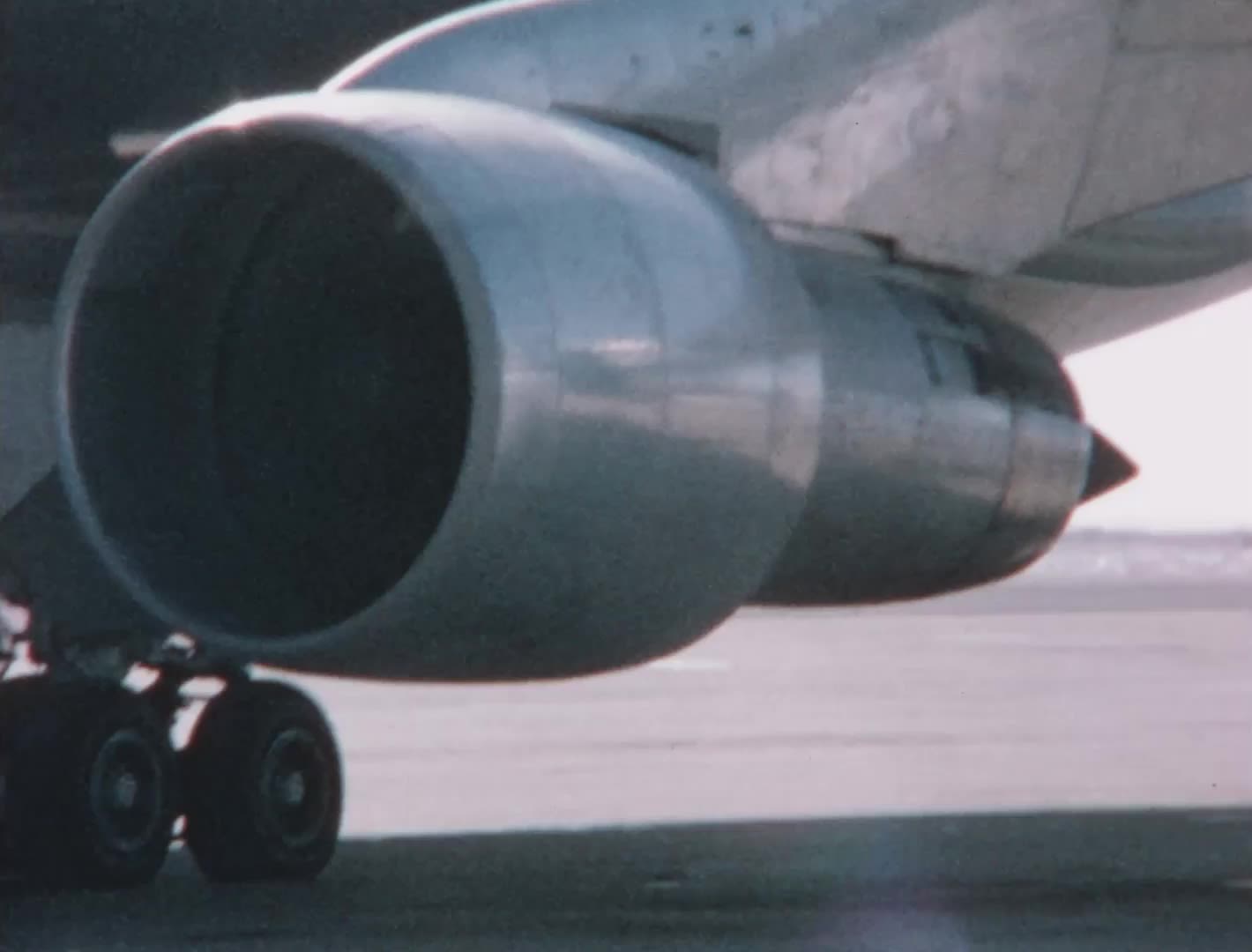
P&W JT9D engine start at Roswell 1970 (Richard Boucher Collection/Pan Am Historical Foundation).
P&W JT9D engine start at Roswell 1970 (Richard Boucher Collection/Pan Am Historical Foundation).
Investigators learned that Pratt & Whitney had been aware of the potential weakness but had not shared the information with Boeing—a revelation that strained their partnership.
Replacement shafts were quickly supplied, but trust proved harder to repair. Additional redesigns were also required to address cracking that developed in the engine inlet panels after relatively few flight hours.
NEEDED
IMPROVEMENTS
The original demands for thrust to lift the conceptual 747 on paper had to keep pace with the actual airplane as it grew in weight. P&W’s engineers had to utilize new materials to build iterations of the JT9D, while at the same time supplying Boeing with engines for the airplanes coming out of the factory.
The first version of the engine certified by the FAA, in May 1969 — three months after the first flight of the 747 — was the JT9D-3, at 43,500 lbs. of thrust. This was the engine that would power Pan American’s original twenty-five 747s, and it would prove to be a “work in progress,” given the various fixes and adaptations it required in actual use.
Pratt & Whitney JT9D Engine (Pan Am Historical Foundation Collection).
Pratt & Whitney JT9D Engine (Pan Am Historical Foundation Collection).
The next iteration of the engine, the JT9D-7, was produced in 1971 and it could operate at higher thrust, and without headaches. In fact the next twenty years would see continual evolution of the JT9D which stayed in production to 1990.
By then, it was powering several other aircraft models, both for Boeing and Airbus, and was certified for extended twin operating service (ETOPS) confirming its ability to safely keep twin-engine airliners flying on a single engine on long overwater flights.
As launch customer, Pan Am received the lion’s share of the initial Pratt & Whitney JT9D high-bypass turbofans, experiencing what the tech world would call the "bleeding edge." The combustion stage operated at extreme temperatures, demanding metallurgical advances to be developed simultaneously with the engine.
JT9D PROTOTYPE
VIDEO
The prototype first flew on a borrowed B-52 in June 1968 — just eight months before the 747's first flight.
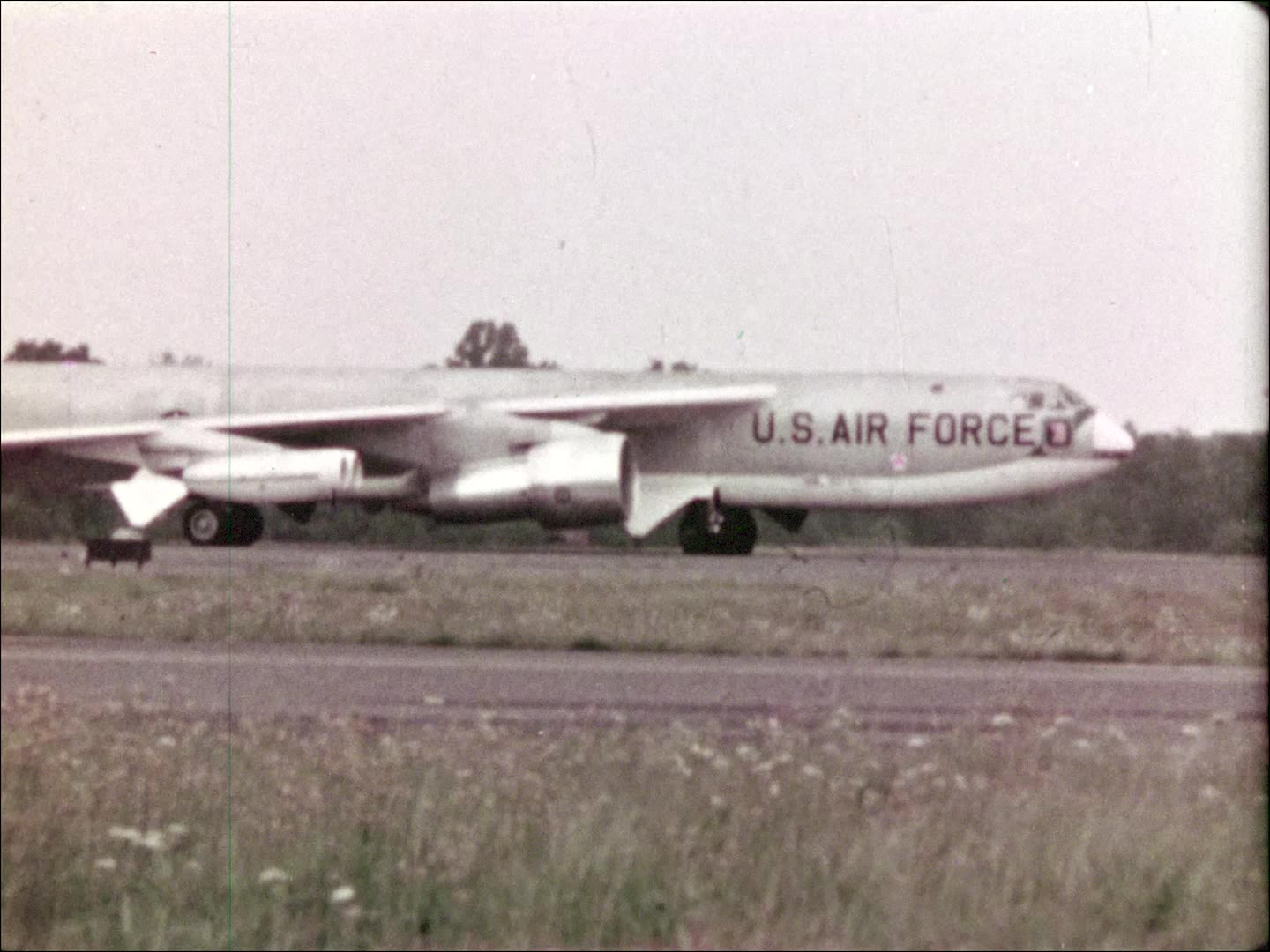
A prototype single test installation of P&W's JT9D was made in the summer of 1968 on a borrowed USAF B-52 (Pan Am Historical Foundation Film Collection).
A prototype single test installation of P&W's JT9D was made in the summer of 1968 on a borrowed USAF B-52 (Pan Am Historical Foundation Film Collection).
DELAYS
P&W couldn't produce engines fast enough, and 747s emerged from the Everett plant with concrete blocks where engines should be (to balance the airframes), cascading production delays onto Pan Am's plans.
BUGS
The Superjets were safe but plagued with “bugs.” P&W engines suffered oil loss, fires, overheating, and in-flight shutdowns.
JT9D Engine Problems
"As a corollary to growth of the airplane was a need for growth in engine thrust. The JT9 was a totally new engine the first ever designed directly for a new commercial airplane. It was on the same tight development schedule as the airplane, but now a level of take-off thrust was being demanded that had not been expected until after several years of airline service... engine deliveries were late. We did not see any engines at Everett until shortly before roll-out of the first airplane at the end of September 1968."
-- Robert Blake, Pan Am Representative at Boeing.
RON MARASCO'S EXPERIENCE
The JT9D Turbofan
Performance
“…the early operation of the 747 … was plagued by serious in-flight incidents, overwhelmingly poor engine reliability, and numerous mechanical aircraft system problems.”
-- Ronald Marasco, “The 747: A Tumultuous Beginning,” p. 57.
Frame from "The Superjet" showing JT9D startup (Pan Am Historical Foundation Film Collection).
Frame from "The Superjet" showing JT9D startup (Pan Am Historical Foundation Film Collection).
Ron Marasco witnessed Pan Am’s early problems with the 747s as Manager of Maintenance for the 747 at JFK. He was present on January 21, 1970, when the first scheduled commercial flight -- PA 2 from JFK to London -- had to operate with a quickly-replaced aircraft minutes after taxiing away from the terminal with a shut-down engine.
In his insightful book, Ron described challenges with those first 747s, many caused by unreliable JT9Ds, excessive engine changes and rebuilds (often costing over one million dollars each). There was also the difficult business of mounting a replacement engine to the wing of another 747 with a special “fifth-engine pod” when needed at some far away base.
In operation, those early JT9Ds caused in-flight shutdowns, flight turn-arounds, disturbing “compressor stalls,” and even fires, resulting in airplanes sitting on the ground when they should have been carrying passengers and freight.
Some trouble resulted from "ovalization" — mismatched clearance between spinning turbine blades and out-of-round housings. At best, this lowered fuel burn efficiency. At worst it could wreck an engine. As a fix, Boeing redesigned engine mounts, requiring more downtime. Another necessary fix was a water-injection system devised to cool the engines and boost take-off power. And there were other problems lurking inside those early JT9Ds that brought matters to the attention of government authorities.
COMING TO GRIPS
Two incidents brought matters front and center. On August 17th, 1970 an Air France 747 lost an engine after leaving Montreal -- a turbine blade exploded out of an inboard engine. One month later, an American Airlines flight suffered the same scenario departing SFO. Both aircraft landed safely without injuries to anyone onboard.
The NTSB & FAA
Alarmed by these incidents, the National Transportation Safety Board (NTSB) convened a meeting with FAA officials in early October. Some at the NTSB suggested grounding the fleet, while the FAA resisted such drastic action. The joint conclusion mandated more frequent engine inspections and close monitoring during flight. The 747s kept flying.
Engine inspections and monitoring notwithstanding, the Superjet had other technical issues causing above average maintenance and unscheduled service interruptions.
CONFERENCE AT
THE PAN AM BUILDING
April 1971. Pan Am led an all-hands conference at the Pan Am Building with other airlines, Boeing, Pratt & Whitney, the FAA, and others. They reviewed engine problems along with structural/operational issues, and considered future improvements.
Topics included not only the 747’s powerplants, but noise certification, issues with ground steering systems, rudders, and flaps, hydraulics, braking, and problems with entry doors and slides – to name a few.
The meeting outlined a roadmap for improving operational reliability and affirmed the 747's future. With industry stakeholders engaged, the issues impacting this brand-new airplane could be tackled in a cooperative and organized approach. The 747 would keep flying and present more manageable issues going forward for operators.
Timing Is Everything
THE RECESSION
The Superjet had taken off in a recession and by 1970 anticipated passenger loads had thinned, "overcapacity" became the industry buzzword and the economy was undercutting efforts to turn reliability into profitability.
Boeing's workforce downsized from 102,000 in 1966 to under 38,000 in 1971. While Boeing and Pratt & Whitney were working out their differences, Boeing even considered General Electric as an alternative engine supplier.
The financial effect on Pan American was also heavy and forced the company to keep its 707 operations going — retaining planes they had hoped to sell.
For Pan Am, the effects of the recession were also substantial. Net earnings turned negative and remained that way for several years. Denied domestic routes by the Civil Aeronautics Board, Pan Am didn't escape high foreign landing fees, fuel taxes, navigation fees, and other non-negotiable costs.
JFK building concept for the new 747s in "Clipper Cockpit," December 1969 (University of Miami Special Collections).
JFK building concept for the new 747s in "Clipper Cockpit," December 1969 (University of Miami Special Collections).
Added Expenses for Pan Am
Along with 33 new 747s came expenditures for facilities at Pan Am bases. These included the new JFK Worldport terminal and maintenance facilities, including ground service equipment and spare engines, etc.
Taken as a whole, the cost to Pan American for all costs related to the acquisition of the 747 amounted to one billion dollars!
1972: Pan Am's New Chairman
Pan Am's William Seawell, photo taken in 1976 (Pan Am Historical Foundation Collection).
Pan Am's William Seawell, photo taken in 1976 (Pan Am Historical Foundation Collection).
Metrics for daily aircraft utilization began to improve and seating capacity on the 747s was raised to maximize their effective usage.
The new chairman, Former Air Force Brigadier William Seawell fought to cut cost and improve efficiency, with some success.
Pan Am cancelled purchase of eight supersonic Concordes in January 1973. But that same year, OPEC quadrupled oil prices worldwide — Pan Am was particularly vulnerable with its substantial overseas route network, where fuel often cost 50% more than in the USA.
Pan Am
Builds for The Future
For Pan Am, like other airlines flying the 747, it would take a while to absorb the effects of the Superjet, and to see the promised benefits from the big new planes.
The 747 would profitably serve Pan Am's longest routes such as Los Angeles to London and New York to Rio.
It would be the airliner that could deliver huge new economies of scale for both passenger and freight operations.
The day would come that heralded the new era in aviation.
Pan Am 747 Cargo plane with Pan Am trucks (Pete Runnette/Pan Am Historical Foundation Collection).
Pan Am 747 Cargo plane with Pan Am trucks (Pete Runnette/Pan Am Historical Foundation Collection).
EXPLORE MORE PAN AM HISTORY !
JOIN US !
 Built with Shorthand