
A snapshot of Pan Am's leadership past, present and future in 1969. Left to right, Chairman Harold Gray, Retired Chairman Juan Trippe and current President Najeeb Halaby.
A snapshot of Pan Am's leadership past, present and future in 1969. Left to right, Chairman Harold Gray, Retired Chairman Juan Trippe and current President Najeeb Halaby.
INTRODUCING A NEW ERA IN AVIATION!
Photo by PAA Photographer Paul Friend showing N733PA, the 747 that was first delivered to Pan Am on December 12, 1969. (Pan Am Historical Foundation Collection).
Photo by PAA Photographer Paul Friend showing N733PA, the 747 that was first delivered to Pan Am on December 12, 1969. (Pan Am Historical Foundation Collection).
December 1969 marked 48 months since Pan American's Juan Trippe and Boeing's Bill Allen signed the Letter of Intent to create the 747 — a remarkably compressed timeline from concept to reality.
In the interim, hundreds of millions were spent and borrowed, the world's largest building was constructed, the design evolved from double-deck to widebody, and maximum weight increased from 275 to 355 tons.
On December 31st, the FAA certificated the Boeing 747 as a commercial transport. The road ahead was clear, and the Superjet's career could begin.
Pan Am wasn't just the launch customer — the airline had shaped what the 747 had become. They would fly it first, receiving twenty-five B747-121s by late Spring 1970, plus eight more in 1971. Pan Am had to jockey to maintain its position as the world's first operator when TWA attempted preemptive "test flights," but Boeing honored Pan Am's objections.
"CLIPPER CONSTITUTION"
PROVING FLIGHT
JFK to LHR
Pan Am proving flight at Heathrow, the morning of January 12th, 1970 with "Clipper Constitution," piloted by Capt. Jess Tranter carried 360 passengers, among them 160 Pan Am employees. A continuation to Frankfurt Germany was prevented by bad weather and an engine change. (Photo: "Pan Am Clipper," January 19, 1970, p. 3 University of Miami Special Collections).
Pan Am proving flight at Heathrow, the morning of January 12th, 1970 with "Clipper Constitution," piloted by Capt. Jess Tranter carried 360 passengers, among them 160 Pan Am employees. A continuation to Frankfurt Germany was prevented by bad weather and an engine change. (Photo: "Pan Am Clipper," January 19, 1970, p. 3 University of Miami Special Collections).
Prior to the opening of Pan Am's 747 scheduled service, in January 1970, Britain saw the arrival of the first 747 on a proving flight. This British Movietone newsreel conveys some of the awe-struck reactions the new aircraft made at the time. (Courtesy AP Archive.)
747
CHRISTENING
AT DULLES
Christening Ceremony of Pan Am 747 re-named "Young America," January 15, 1970 at Dulles International. Pan Am President Najeeb Halaby and First Lady Pat Nixon (Pan Am Historical Foundation Film Collection).
Christening Ceremony of Pan Am 747 re-named "Young America," January 15, 1970 at Dulles International. Pan Am President Najeeb Halaby and First Lady Pat Nixon (Pan Am Historical Foundation Film Collection).
Pan Am President Najeeb Halaby and First Lady Pat Nixon christen "Clipper Young America" and take a tour of the plane (Pan Am Historical Foundation Film Collection).
Pan Am Chairman Najeeb Halaby and First Lady Pat Nixon christen Clipper Young America and take a tour of the plane (Pan Am Historical Foundation Film Collection).
PRE-INAUGURAL TOUR FLIGHTS
As soon as the 747 christening ceremony was complete, Pan Am launched hour-long courtesy flights in a dozen US cities, plus San Juan, Puerto Rico and London. Accompanying displays introduced the 747 in detail to potential customers. Following the January Inaugural to London, Pan Am embarked on another set of tours including new 747 destinations in Europe.
Recap from"Pan Am 747 Newsletter," February 1970 (University of Miami Special Collections).
January 22, 1970
FIRST FLIGHT TO LONDON
Before take-off Capt. Weeks had issues with No. 4 P&W engine.
This was the first flight for paying passengers to cross the Atlantic in a Boeing 747.
Over the years, Pan Am’s reputation for festive send-offs had developed alongside the size of its aircraft. The new 747 was more than twice the capacity of the 707. And Pan Am marked the occasion with a bon voyage celebration for first-class travelers in the elegant Presidential Lounge at JFK, presented in Pan Am style from modern design to gourmet fare.
Widebody 747 at JFK before inaugural flight to London, January 1970 (University of Miami Special Collections, Pan American World Airways, Inc. records).
Widebody 747 at JFK before inaugural flight to London, January 1970 (University of Miami Special Collections, Pan American World Airways, Inc. records).
After passengers boarded 747 "Clipper Young America," Captain Robert Weeks aborted takeoff due to an overheating issue in an engine. After being escorted off the plane to nearby restaurants, passengers returned for transfer to the backup plane, N736PA "Clipper Victor," which was renamed "Clipper Young America" for this flight to London.
By 1:30 AM travelers re-boarded and twenty minutes later took off in the new jet. For the duration of the six hour flight they would mingle, dine from a lavish buffet, sample the bar and explore the aircraft’s spacious interior with flight attendants taking all the last-minute changes in stride.
The Superjet landed to cheers at LHR, ushering in a new era of international travel that would bring people and cultures closer than ever.
Recap of "Historic First Flight: 'Suddenly Whole Thing Begins to Move' by Stephen E. Eastman, "Boeing News," Feb. 5, 1970 .
FIRST 747 PASSENGER FLIGHT
PAN AM: JFK TO LHR
At the 747 gate, prior to January 1970 inaugural flight from JFK to LHR (Pan Am Historical Foundation Film Collection).
At the 747 gate, prior to January 1970 inaugural flight from JFK to LHR (Pan Am Historical Foundation Film Collection).
Passengers disembark Clipper Young America with disabled engine, to wait for the backup 747, Clipper Victor, to fly them on the first 747 passenger flight in history from JFK to LHR.
Passengers disembark Clipper Young America with disabled engine, to wait for the backup 747, Clipper Victor, to fly them on the first 747 passenger flight in history from JFK to LHR.
Actual 747 Flight to Lo.ndon from New York on January 22, 1970 seen at JFK before takeoff (University of Miami Special Collections, Pan American World Airways, Inc. records).
Actual 747 Flight to Lo.ndon from New York on January 22, 1970 seen at JFK before takeoff (University of Miami Special Collections, Pan American World Airways, Inc. records).
Pan Am Superjet in London, 1970 (Pan Am Historical Foundation Film Collection).
Pan Am Superjet in London, 1970 (Pan Am Historical Foundation Film Collection).
Pan Am Superjet - unloading luggage after London arrival, January 1970 (Pan Am Historical Foundation Film Collection).
Pan Am Superjet - unloading luggage after London arrival, January 1970 (Pan Am Historical Foundation Film Collection).
Pan Am 747 and crew after landing at LHR London on the first paying passenger flight across the Atlantic from JFK New York, January 22, 1970 (Pan Am Historical Foundation Collection).
Pan Am 747 and crew after landing at LHR London on the first paying passenger flight across the Atlantic from JFK New York, January 22, 1970 (Pan Am Historical Foundation Collection).
THE STYLE FOR THE '70s
Stewardess Uniforms. Introducing "The New Look," March 1969 (University of Miami Special Collections).
Stewardess Uniforms. Introducing "The New Look," March 1969 (University of Miami Special Collections).
At the same time as the 747 mockup model was being finalized with, Pan Am's executives were contemplating how to develop a new look for the new age that was about to begin with the arrival of the Superjet. A significant factor they considered were the uniforms of flight service personnel.
The 1960s look that had evolved with Don Loper's for the 707s would be superceded by something completely different. Frank Smith and Joseph Picone, of Paris fashion house Evan-Picone, were tapped to create a unique uniform for Pan Am. Its most distinctive element was the bowler-style hat.
PAN AM FLIGHT ATTENDANTS
IN UNIFORM
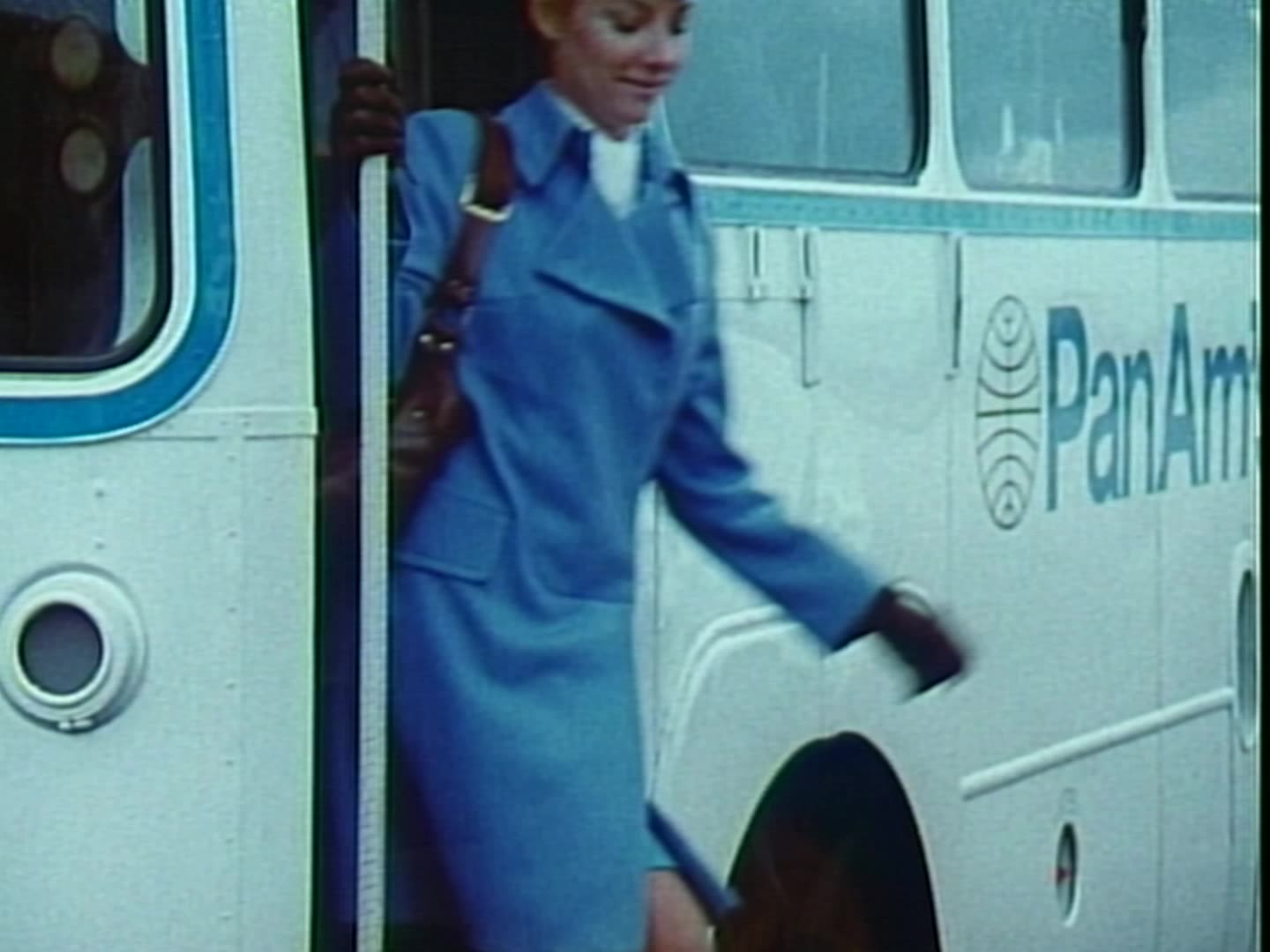
Pan Am Stewardess footage from the Pan Am Historical Foundation Film Collection.
Pan Am Stewardess footage from the Pan Am Historical Foundation Film Collection.
WORKING ABOARD
For cabin crews, early experiences proved that in-flight work would need adjustments to the new 747 space.
Stewardesses model their uniforms (Courtesy AeroArt International).
Stewardesses model their uniforms (Courtesy AeroArt International).
For instance, the 707-style individually-served portions from heavy, unwieldy carts proved dysfunctional, so that eventually, tray service proved to be the answer.
Flight Director
A new position of Flight Director was created to oversee cabin services with responsibility for everything on the passenger side of the flight.
Ted Johnson, with experience dating to the flying boat days, recalled anomalies during an interview in 1992 (Pelican Films). The innovative electronic "multiplex" system avoided 600 pounds of of dedicated wiring for every signal. But it did cause bizarre incidents like call buttons flashing in unison throughout the cabin.
The "Theater in the Air" movie system – which used actual movie film circulating around the aircraft cabin – was often surprising. Ted remembered unexpected water leaks from the ceiling too.
"Every so often, the break-in problems in the 747 have a light touch. Pan Am’s 747s have a multiplex electrical system, to feed lights, call button power, PA calls, stereo music and movie sound tracks to speakers and seats through the airplane. The system has had its problems, but a special one popped up during the screening of the movie, "Ice Station Zebra."
In one scene, there are a number of under-ice explosions and they are loud and spectacular. They’re so powerful that booms on the sound track set the reading lights to flashing throughout the cabins, adding quite a bit to the confusion if not to movie enjoyment.
Latest report from Maintenance: 'The seat boxes are being modified to decrease their sensitivity to external frequency vibration.' "
"Pan Am 747 Newsletter," August 1970 (University of Miami Special Collections).
"WAKE-UP, IT'S MORNING”
A FULL-COURT PRESS FOR PAN AM TRAINING
A year before the Superjet carried any paying passengers, Pan Am was gearing up to train and orient thousands of employees about what to expect and how to carry out technical and operational procedures that the new aircraft would require. The intensive educational program began with supervisors at JFK from Supply, Maintenance, Ground Operations, and Flight Operations Departments. Jack Kenneally, Maintenance Training Manager described it as a “wake-up, its morning” orientation. The intensive educational program would soon spread to every level of the company systemwide.
--Pan Am Clipper cover story, January 1, 1969 (University of Miami Special Collections).
Pan Am was far more than just airplanes. It was the thousands of workers who maintained and kept the system running. Maintenance and Operations training was critical.
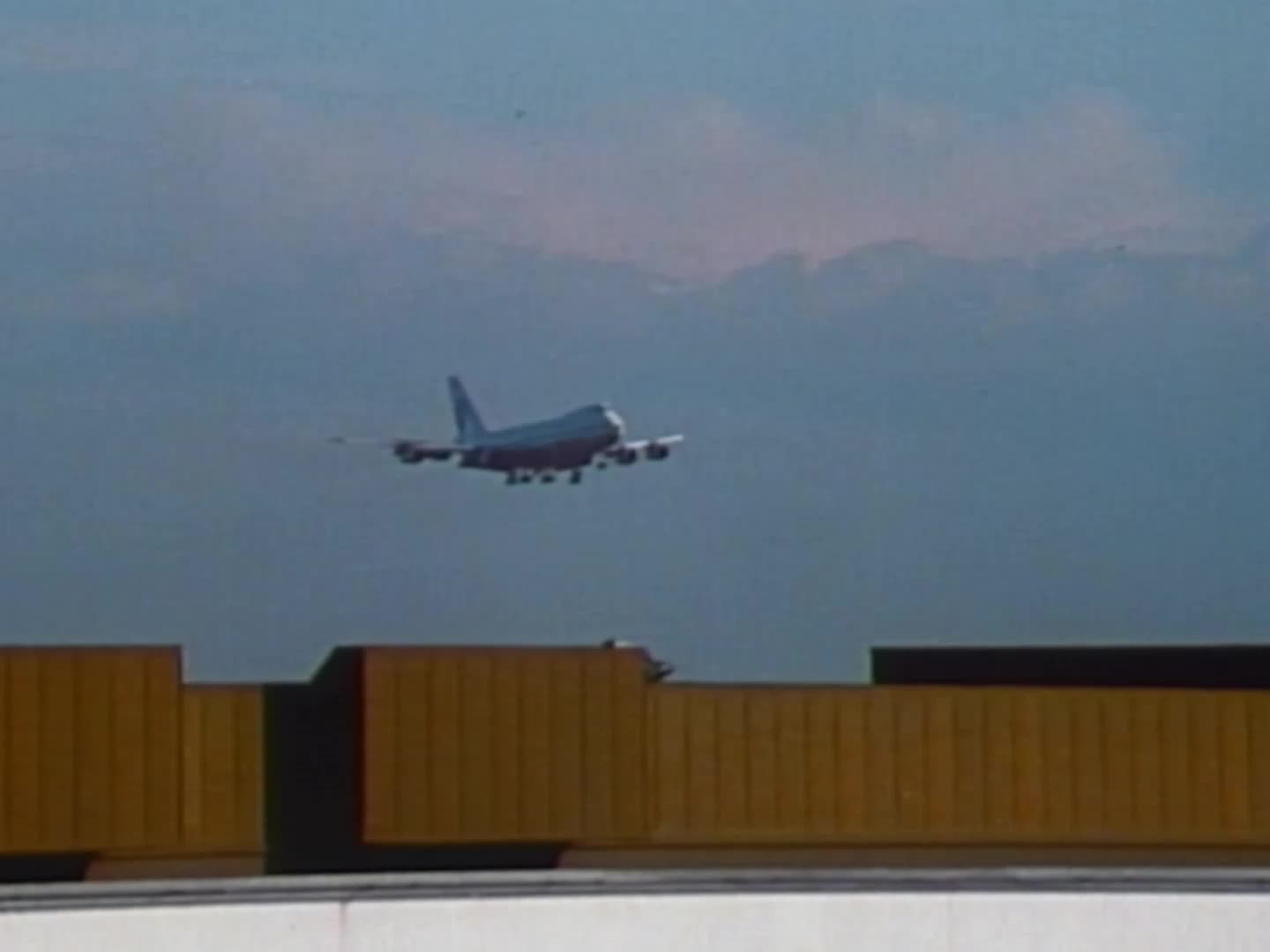
Pan Am Operations activities (Pan Am Historical Foundation Film Collection).
Pan Am Operations activities (Pan Am Historical Foundation Film Collection).
"Stewardesses aren't born." Training for 747 inflight service. ("Pan Am Clipper ," March 2, 1970 by Grace Bohne, p. 8, University of Miami Special Collections).
"Stewardesses aren't born." Training for 747 inflight service. ("Pan Am Clipper ," March 2, 1970 by Grace Bohne, p. 8, University of Miami Special Collections).
COUNTING THE SILVER
The logistics of running an intercontinental airline are understandably complex, but the 747 will establish a new record in at least one department. To provide meals and refreshments for 362 passengers, the commissary service crew, wherever it is, will put together 11,000 individual pieces of equipment for the flight, ranging from the shrimp cocktail fork all the way around to the hot towel.
"747 Newsletter," December 1968 (University of Miami Special Collections).
THE
ENTHUSIASM
CONTINUED
"Early passenger surveys indicate most travelers prefer the airy spaciousness and added leg and elbow room of the 747."
"New York Times," June 1, 1970, p. 70.
A THRILL FOR PASSENGERS
Pan Am 747 Advertisement "What Is It?" (J. Walter Thompson Advertising Collection, Duke University / Erik Sorensen Collection).
There was some nervousness about excessive hype. Pan Am's Director of Advertising Murray Barnes worried about unrealistic expectations of lounges, bars, and rock-bottom fares. He believed the industry should emphasize the 747 as stable, quiet, and spacious. Despite the increased thrust compared to B-707 flights, the JT9D engines were more quiet and smokeless.
The chance to ride the "Jumbo 747" thrilled many passengers. Its roomy cabins, developed with design firm Teague & Associates, featured innovations including galleys and lavatories moved from outer walls (opening window seats), windows set in "architectural reveals" with soft lighting, and enclosed overhead bins — an improvement over open shelving.
For most passengers, the 747 was an exciting adventure. They could stretch their legs while crossing oceans, and enjoy unprecedented entertainment via 10 stereo audio channels and movies on six screens. The widebody seating minimized middle seats with two-four-three clusters split by two aisles. Seats were bigger too.
747
ADVANCED FEATURES
A PILOT'S DREAM
Pan Am 747 Advertisement "Classy Travel" (J. Walter Thompson Advertising Collection, Duke University / Erik Sorensen Collection).
Pilots praised the "Seven-Four" as easy to fly, with advanced controls including automated landing options. The flight deck incorporated input from working pilots, notably Pan Am's Chief Pilot Scott Flower. The revolutionary Inertial Navigation System (INS) eliminated the flight navigator role. Even taxiing from the thirty-five-foot-high cockpit provided improved situational awareness.
Pan Am insisted the plane be accommodated at any airport serving 707s, so Joe Sutter's team devised innovative trailing and leading-edge wing flaps to achieve this. Pan Am had also assisted Boeing’s sales efforts with foreign airlines, in order to preclude being shut out of foreign markets by nations that did not have their own 747s.
A little-noted pioneering advance in aviation technology was the beginning of satellite communications technology installed as original equipment on Pan Am's 747s. It would take some time to reach its potential but the foundation in 1970 was already there.
"You'll see the SATCOM antenna mounted on Pan Am's 747s, in a little bulge just back of the lounge area on top of the fuselage."
"747 Newsletter,"April 1970 (University of Miami Special Collections).
THE MOOD WAS UPBEAT!
LISTEN!
The Sound of the 70s
Pan Am's "Theatre in the Air" offered unique inflight listening and a wide range of selections.
THE 747:
STRONG & SAFE
Safety Through Redundancy
Despite early problems, the basic design proved itself. Joe Sutter's, Boeing's, and Pan Am's philosophy held. In a February 1971 Pan Am flight departing SFO, the plane, directed to an incorrect runway, struck end-of-runway lights, severely damaging the rear of the plane and disabling three of its four hydraulic systems.
The fourth remained functional, enabling a safe return!
In Recognition of An Aviation Milestone
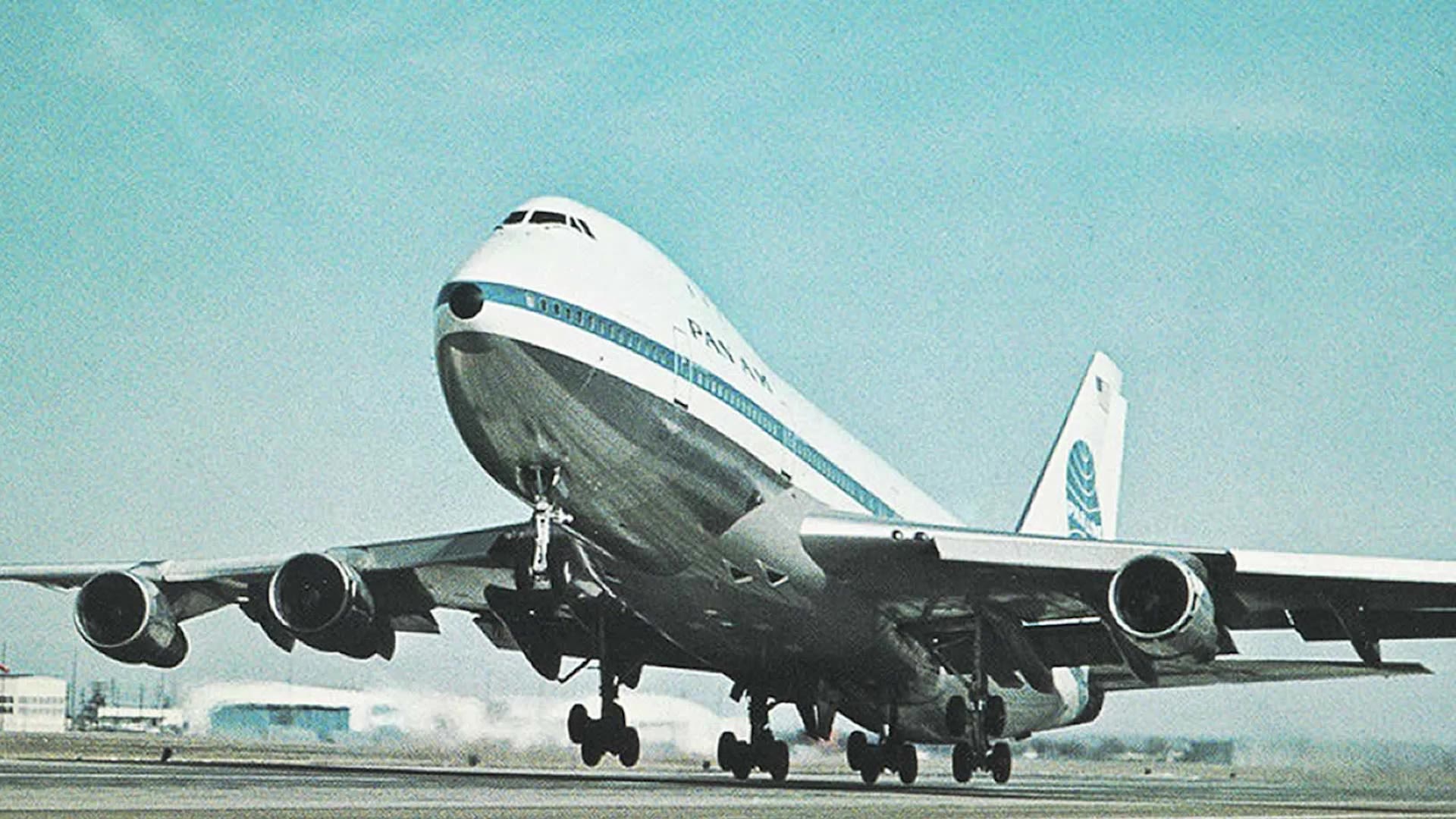
Pan American World Airways 747 (Pan Am Historical Foundation Collection).
Pan American World Airways 747 (Pan Am Historical Foundation Collection).
In May 1971, the prestigious Collier Trophy for 1970 was awarded to Boeing for the 747, recognizing the "industry-airline-government team which successfully introduced the 747" with particular recognition to Pratt & Whitney and Pan Am. The award could have seemed premature amid then-current technical problems, but it proved a worthy honor in the years to come.
An Open Letter
The New York Times
At the one-year anniversary of its 747 service, Pan Am published an open letter in the New York Times with a byline by Chairman Najeeb Halaby. While admitting to issues, particularly with the Superjet’s engines, Halaby struck a hopeful note:
"First, let me say how intensely proud we are of this aircraft... I am convinced that with this airplane rests the future of air travel for many years to come. It is a superb flying machine. Safer, smoother, stronger and more reliable than any other aircraft in history. Despite …challenges, the Pan Am 747, first of a new generation· of wide-bodied jets, has emerged a distinct success.”
Chairman Najeeb Halaby as quoted in the "New York Times," January 21, 1971, p. 36.
EXPLORE MORE PAN AM HISTORY !
JOIN US !
 Built with Shorthand