
(COPY)
INDUSTRY-ALTERING AIRCRAFT
Pan Am's Douglas DC-3 arrived in the mid-1930s, and became a durable, profitable workhorse in Pan Am's fleet (Pan Am Historical Foundation Collection).
Pan Am's Douglas DC-3 arrived in the mid-1930s, and became a durable, profitable workhorse in Pan Am's fleet (Pan Am Historical Foundation Collection).
The Boeing 747 holds a unique place in global aviation. Perhaps only the Douglas DC-3 might be considered its equal in terms of importance to the industry.
With the arrival of both planes, the world turned a corner towards a more universal way to get people into the air.
Each plane eliminated constraints that stifled commercial and popular acceptance of aviation’s potential.
Each aircraft proved itself to be durable, versatile, and safe.
Like the DC-3, the iconic status of the Boeing 747 is not likely to be challenged for a long time.
FIVE DECADES AND COUNTING
The Superjet heyday as a passenger transport has been eclipsed by newer aircraft that fly long routes now on only two powerful turbofan engines.
But the fact that there has been so much growth in air traffic over the years is a legacy of standards of efficiency and technological advances brought to life with the 747.
Particularly worth noting: the 747 was a product of engineering and design done mainly on paper — a testament to human capabilities and vision.
With the arrival of the 747, commercial aviation turned a page on one era and entered a new one.
It was not the easiest of transitions, but the technological innovations driven by Juan Trippe’s idea of a new scale of commercial aircraft, and Bill Allen’s courage to bet Boeing’s future to build it, eventually remade the way world has been flying ever since.
Hangar work and scaffolding, Boeing 747 production site (Courtesy AeroArt International).
Hangar work and scaffolding, Boeing 747 production site (Courtesy AeroArt International).
Clipper Juan T. Trippe at JFK, after the closure of the company (Pan Am Historical Foundation Collection).
Clipper Juan T. Trippe at JFK, after the closure of the company (Pan Am Historical Foundation Collection).
Pan American World Airways would remain a 747 airline to the day it shut down operations at the end of 1991. The image of Pan Am’s iconic Blue Ball logo proudly adorning the massive seven-story-tall-tail of a Boeing 747 will be recognizable for years to come as a reminder of its preeminence in commercial aviation. That logo on that airplane defines just how Pan Am pushed the envelope — and the world followed.
THE 747 GAME CHANGER
Pan Am, guided by Juan Trippe's vision, had gambled on the 747. Unlike prior gambles — first airline to fly an ocean, first to schedule around-the-world service, first successful jet service — this gamble delivered equivocal results. The 747 undoubtedly brought a new stage in air transport. Eventual sales and operational records would prove its value. Would it have been developed and built without Pan Am? What other airline had the status and credibility to make it happen? There was no other.
By July 1970, nine airlines operated the 747. Three months later, Boeing completed its 100th aircraft. Airlines big and small wanted its promise of superior operational efficiencies and they wanted to catch the wave of the future. Despite teething issues, the 747 represented a new paradigm, pushing the world into a new era. More people would fly, generally paying less.
Juan Trippe's Promise
It wasn't the 747’s speed — though faster than previous jets — and it outlived the supersonic Concorde. The 747, as Trippe had envisioned, opened a more expansive age of global air travel to far more people. Its design proved robust and capable of evolution. Its manufacture continued through the final 747-8 in 2023.
Why was this airplane such a turning point?
• Pioneered widebody design – a new standard for passenger comfort, freight efficiency and capacity.
Pan Am Ad, 1967, showing interior and spiral staircase (University of Miami Special Collections).
Pan Am Ad, 1967, showing interior and spiral staircase (University of Miami Special Collections).
• Pioneered high by-pass turbofan engines – a paradigm shift for powering aircraft, eventually enabling twin-engine over-ocean routes.
What's Missing From This Picture? (Smoke). This Pratt & Whitney Ad appeared in Pan Am's Clipper Magazine Souvenir publication in 1970, p. 13 (University of Miami Special Collections).
What's Missing From This Picture? (Smoke). This Pratt & Whitney Ad appeared in Pan Am's Clipper Magazine Souvenir publication in 1970, p. 13 (University of Miami Special Collections).
• Evolved airline route structures – higher efficiency and lower costs brought lower fares, expanded flying public, and new point-to-point routing linking city pairs formerly requiring connections.
Pan Am Route Map from Timetable, Feb/Mar/Apr 1972, pp 28-29 (Courtesy University of Miami Special Collections).
Pan Am Route Map from Timetable, Feb/Mar/Apr 1972, pp 28-29 (Courtesy University of Miami Special Collections).
By the end of 1970, Boeing was looking forward to improved JT9D engines and drafted the evolved 747-200B with 5,600 nautical mile range. Original 747-100s were modified with improved JT9D-7 engines delivering 45,000 lbs. thrust and higher maximum takeoff weight.
New Designs Based on the 747
The Superjet’s long-term future proved remarkably successful. Initial difficulties didn't hamper the decades-long trajectory. As Joe Sutter and his Boeing colleagues had hoped, the basic design proved a flexible platform for successive variants:
· The "Combi" (first sold to Sabena) – flexible combined freight and passenger capacity.
· High-capacity Shuttle variant – for Japan, carrying 500+ passengers on short-turnaround flights.
· Freighter version with tilt-up nose – part of original variant designs.
· 747-SP – enabling nonstop New York-Tokyo flights, a Pan Am-requested design. A Pan Am 747SP made two round-the-world flights: around the equator and over both poles, each flight needing only two stops to refuel.
(Pan Am Historical Foundation Collection).
(Pan Am Historical Foundation Collection).
· Successive variants through the 747-8 – improving range, aerodynamics, avionics, and amenities, with 1,573 aircraft produced by 2023.
Most popular:
The 747-400, introduced in 1989!
· Special applications – Air Force One, two NASA Shuttle carriers, and NASA's SOFIA high-altitude infrared telescope (converted from former Clipper Lindbergh, a Pan Am 747-SP)
The Space Shuttle orbiter Atlantis, framed by the California mountains, as it rides on the back of one of NASA's Boeing 747 w:Shuttle Carrier Aircraft (SCA) en route from California to the Kennedy Space Center, Florida, after a ten month refurbishment. (By NASA / Carla Thomas - Armstrong Photo Gallery: Great Images in NASA: Public Domain, Wikimedia Commons).
The Space Shuttle orbiter Atlantis, framed by the California mountains, as it rides on the back of one of NASA's Boeing 747 w:Shuttle Carrier Aircraft (SCA) en route from California to the Kennedy Space Center, Florida, after a ten month refurbishment. (By NASA / Carla Thomas - Armstrong Photo Gallery: Great Images in NASA: Public Domain, Wikimedia Commons).
Former Pan Am 747 SP "Clipper Lindbergh" became the SOFIA Flying Infrared Observatory, 16 July 2013, NASA photo / Jim Ross (Wikimedia Commons).
Former Pan Am 747 SP "Clipper Lindbergh" became the SOFIA Flying Infrared Observatory, 16 July 2013, NASA photo / Jim Ross (Wikimedia Commons).
Pan Am 747SP participated in NASA's GASP (Global Air Sampling Program) NASA from 1975 to 1979 ( National Archives and Records Administration, Wikimedia Commons).
Pan Am 747SP participated in NASA's GASP (Global Air Sampling Program) NASA from 1975 to 1979 ( National Archives and Records Administration, Wikimedia Commons).
Air Force One, the typical air transport of the President of the United States of America, flying over Mount Rushmore February 10, 2001 (Air Force Photo, Wikimedia Commons).
Air Force One, the typical air transport of the President of the United States of America, flying over Mount Rushmore February 10, 2001 (Air Force Photo, Wikimedia Commons).
POSTSCRIPT
“The Queen of the Skies”
56 Years On
Pan American World Airways inaugurated the world’s first Boeing 747 “Superjet” service on January 22, 1970.
More than half a century later are there any 747’s still flying? Indeed, there are.
In fact, as of January of 2026, at least 427 Boeing 747’s are still active out of a grand total of 1,574 manufactured near Seattle between 1968 and 2023.
Of those 427 aircraft the vast majority are 747-400F cargo jets, many of which were converted to that role from originally carrying passengers.
Pan Am 747 with billboard livery (Pan Am Historical Foundation Collection).
Pan Am 747 with billboard livery (Pan Am Historical Foundation Collection).
There are also about 50 Boeing 747-8i “Intercontinental” models, the last variant of the 747 produced, still flying passengers for airlines like Lufthansa and Korean Air. The two new “Air Force One” VC-25B U.S. presidential aircraft now being prepared to replace a pair of vintage 1989 VC-25A’s (known in civilian clothes as 747-200’s) are both 747-8i’s.
Chances are that we will see about another 10 years of front-line passenger service by those 50 -8i’s mentioned earlier.
Both 747-400F and 747-8F freighters, meanwhile, will likely hold out for another 20-25 years. If that holds true it would mean that the last civil 747’s may be phased out up to 80 years after Pan Am’s “Clipper Young America” departed John F. Kennedy International Airport less than one month into the beginning of the 1970’s!
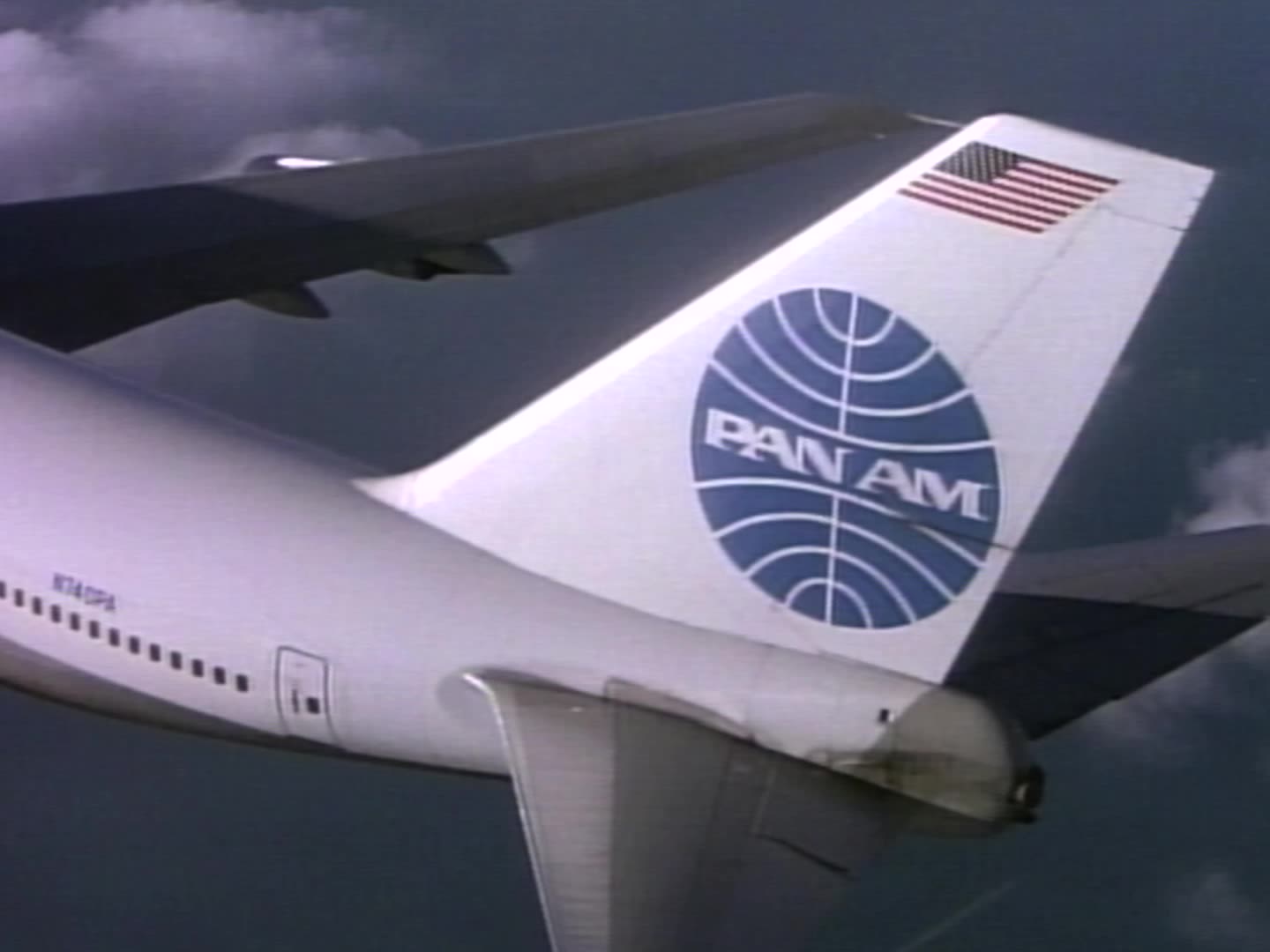
Pan Am 747 Promotional Footage (Pan Am Historical Foundation Film Collection).
Pan Am 747 Promotional Footage (Pan Am Historical Foundation Film Collection).
EXPLORE MORE PAN AM HISTORY !
JOIN US !
 Built with Shorthand