
1968-1969
747 PRODUCTION
BY THE PAN AM HISTORICAL FOUNDATION
THE EVERETT PLANT
Production Timeline
Inside the Everett Factory, the metal 747 model (Pan Am Historical Foundation Film Collection).
Inside the Everett Factory, the metal 747 model (Pan Am Historical Foundation Film Collection).
November 1967. "Rainbow Teams" specializing in an area (each with a different color) —Manufacturing, Engineering, Quality Control and Program Management — began to organize and collaborate on building the actual 747.
January 12, 1968. Production got the go-ahead. In a big ceremony, Engineering and Quality Control "bought" the 747 shell after approving the basic airplane configuration. This marked the official beginning of manufacturing and coordination by each "Rainbow Team" on non-structural features like wiring, tubing and insulation blankets. The teams were looking ahead to the big 747 rollout in autumn of that year.
February 1968. First nose section arrived from Wichita. After that came the joining of sections of the fuselage, followed by installing brackets, tubing and wire bundles. "Approximately 136 miles of wire, enough to stretch between Seattle and Wenatchee will be in each 747." ("Everett Flyer," May 1968).
By May 2, 1968. The teams joined a set of 747 wings to the center box section for the first time ever -- Each of the 105' long wings were created at the Auburn fabrication site and assembled at the Everett site.
July 1968. Only two months until rollout.
" ...the first of hundreds of 747s is past the manufacturing half-way point and well on its way toward rollout Oct. 1 ...
July 1968 Recap ("Everett Flyer," Museum of Flight Archive).
BUILDING THE SUPERJET
Courtesy of The Boeing Company Archive
Model stands in a 747 fuselage at the Everett Plant. (Courtesy The Boeing Company Archive).
Model stands in a 747 fuselage at the Everett Plant. (Courtesy The Boeing Company Archive).
Four-part image, assembling the 747 at the Boeing Everett Factory (Courtesy The Boeing Company Archive).
Four-part image, assembling the 747 at the Boeing Everett Factory (Courtesy The Boeing Company Archive).
Joining the 747 wings at the Boeing Everett Factory (Courtesy The Boeing Company Archive).
Joining the 747 wings at the Boeing Everett Factory (Courtesy The Boeing Company Archive).
An Air Colossus
The Autumn Rollout
September 30, 1968. The 747 was 78% finished, sufficient to bring the first airframe out for public unveiling. It wasn't ready to fly but looked great, with logos of 26 confirmed airline buyers on its nose. It was an auspicious moment with lots of press coverage. Twenty-six flight attendants from various airline customers christened the plane, and thousands of attendees got a glimpse of the future of commercial aviation.
Rollout September 30, 1968 (Courtesy AeroArt International Collection).
Rollout September 30, 1968 (Courtesy AeroArt International Collection).
The first Boeing 747 aircraft ("RA-001," named "City of Everett" now on display at the Museum of Flight) had been painted for its official rollout ceremony that taking place September 30, 1968, a day ahead of the original October 1st deadline.
Before testing began, the Rainbow teams had put in place the necessary tubing, wiring, and onboard systems, verifying that everything operated as intended.
After the rollout, they began ground evaluations that included engine start-ups, taxi runs, and brake performance checks. And for the following two months, the plane was scheduled for several relocations to carry out proof pressure testing, activate the electrical systems, and begin functional evaluations.
During this phase of work, technicians would inspect hydraulic and other lines for leaks while confirming that system clearances, alignments, and fittings all met expected standards.
"Operation Supersneak"
The Boeing 747 displayed to the public for the first time, 09/30/68 (SAS photo, Wikimedia Commons).
The Boeing 747 displayed to the public for the first time, 09/30/68 (SAS photo, Wikimedia Commons).
For the Rollout ceremony, the first 747 was to appear in freshly painted colors — white with a red stripe sporting decals of all the airlines that had purchased the plane so far. The Everett paint hanger was outside the final assembly building, meaning the new plane would have to be rolled out before the formal Rollout, followed by a “rollback" to production facilities when painted.
Nobody wanted the grand debut to be scooped by photographers with telephoto lenses, so they planned to camouflage the plane. But it was the world's largest jet and it took eleven rolls of black plastic to conceal it.
At night, with police blocking traffic, the gigantic plane was towed across the grounds to the paint hangar, while Boeing trailers flanked the route to obscure it.
Inside, 87 painters from two Boeing plants worked on the job in two long 12-hour shifts. Amazingly they completed the job in about the time it took to paint a much smaller 707.
And a day early, the newly painted 747 with its decals and markings was secretly rolled back to the assembly plant, again under the cover of darkness, but this time undisguised so the paint would remain perfectly intact for its debut.
Recap of "Incredible Saga: Operation Supersneak" October 7, 1968 "Everett Flyer," p. 2 (Museum of Flight Archives).
BOEING ROLLOUT
FROM THE PAN AM HISTORICAL FOUNDATION FILM COLLECTION
"The Parade of Giants Has Begun"
"Everett Flyer," Sept. 27, 1968 (Museum of Flight Archive).
SEPTEMBER 1968
PRODUCTION UPDATE
Moving an engine to the factory (Pan Am Historical Foundation Film Collection).
Moving an engine to the factory (Pan Am Historical Foundation Film Collection).
"Superjet No. 2, destined to fly the colors of Pan Am, now looks like a whole airplane... Wings and body have been joined and it's moving down the final assembly line toward its own rollout date...
Behind No. 2, the major assemblies of No. 3 - also a Pan Am - are being readied for assembly...
The wings have already been joined. The nose section is being joined to the forward body while the nose section of No. 4, waits its turn.
And behind these airplanes, the giant sections of more are taking shape, the first in a line of hundreds of this huge new breed of jetliners.
The superjets are on the move and the new task of building the production tempo will challenge the best efforts of all The Incredibles."
-- "Everett Flyer," Sept 27, 1968 (Museum of Flight Archive).
PLANS FOR PAINTING THE PAN AM PLANE
Pan Am had pioneered durable aircraft coatings, developing from brittle epoxies on older planes like the Stratocruiser to tough polyurethanes of the 747s. The 747’s sleek white livery showed just how function meets elegance in aviation design.
Pan Am’s new 747s could endure extreme temperature conditions, pushing its paint to the limit. The finish needed to remain glossy and intact throughout temperature shifts that could vary nearly 180 degrees — tropical heat on the runway to icy altitudes at 35,000 feet. Its metal could potentially shrink by an inch in very cold temperatures while traveling 600 miles per hour. Despite all the possible stresses, the paint layer was only three-thousandths of an inch thick—about 400 pounds in total.
Recap from "747 Newsletter," March 1969 (University of Miami Special Collections).
MARCH 5, 1969
PAN AM'S ROLLOUT
Blue, White & Silver
Pan Am's first plane emerges from the paint hangar
March 5, 1969, the first Pan Am 747 rolled out the Boeing paint hangar ( over of the "Pan Am Clipper," March 17, 1969, University of Miami Special Collections).
March 5, 1969, the first Pan Am 747 rolled out the Boeing paint hangar ( over of the "Pan Am Clipper," March 17, 1969, University of Miami Special Collections).
“The number two 747 received as much photo attention as a movie star when it rolled out of the paint hangar Wednesday morning wearing its sparkling blue, white and silver Pan Am colors…. A 90-foot high canvas, painted to depict a seven story office building, was hung alongside the hangar's huge doors to dramatize the height of the 747's vertical fin. Additional visual contrasts were provided by grouping 50 new cars around the glistening superjet…”
"Everett Bulletin," March 10, 1969 (Museum of Flight Archive).
VIDEO OF THE PAN AM FACTORY ROLLOUT
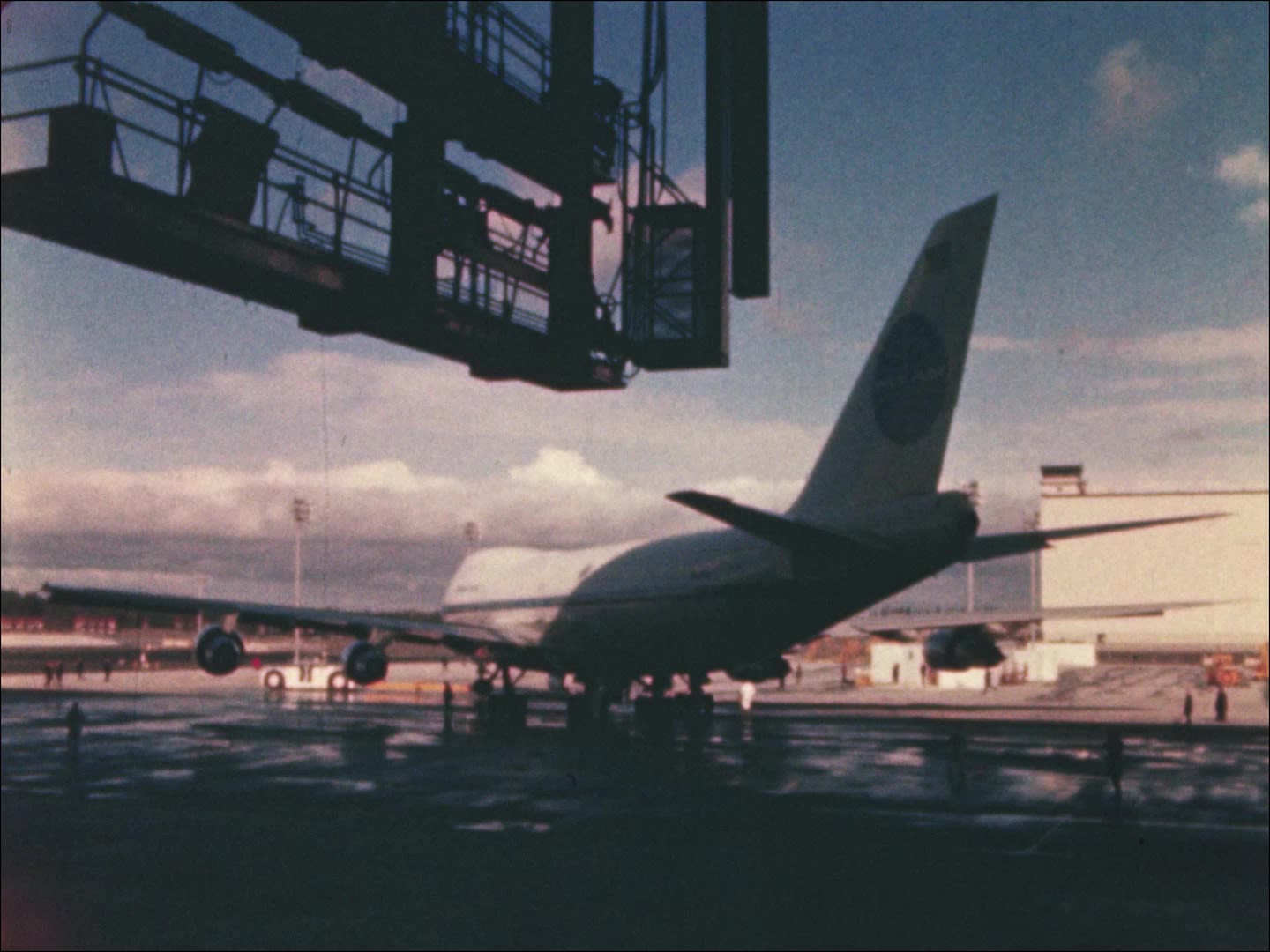
Pan Am N747PA factory rollout, March 5, 1969 (Pan Am Historical Foundation Film Collection).
Pan Am N747PA factory rollout, March 5, 1969 (Pan Am Historical Foundation Film Collection).
STRIKING SIZE COMPARISONS
Pan Am's first plane to rollout (N747PA) which was later named "Clipper Juan T. Trippe" (Pan Am Historical Foundation Collection).
Pan Am's first plane to rollout (N747PA) which was later named "Clipper Juan T. Trippe" (Pan Am Historical Foundation Collection).
The new Pan Am 747 with a Pan Am 707, March 1969 (Pan Am Historical Foundation Collection).
The new Pan Am 747 with a Pan Am 707, March 1969 (Pan Am Historical Foundation Collection).
Photo cover of the "Pan American Clipper," June 23, 1969, "Pan Am 747s Rolling Out: 2 flying 3 on the line" (University of Miami Special Collections).
Photo cover of the "Pan American Clipper," June 23, 1969, "Pan Am 747s Rolling Out: 2 flying 3 on the line" (University of Miami Special Collections).
EXPLORE MORE PAN AM HISTORY !
JOIN US !
 Built with Shorthand