
1965
THE EVOLVING 747
A
NEW TECHNOLOGY
AIRPLANE
BY THE PAN AM HISTORICAL FOUNDATION
THE EVOLVING 747
THE FUTURE WAS CALLING
What About the Subsonic Market?
Frame from "The Superjet," showing a Double-deck 747 Model based on the 707 design (Pan Am Historical Foundation Film Collection).
Frame from "The Superjet," showing a Double-deck 747 Model based on the 707 design (Pan Am Historical Foundation Film Collection).
An Ocean Liner with Wings
At Boeing and Pan Am, concepts of the "New Technology" airplane were being considered. Juan Trippe favored a huge plane with double rows of windows, like an ocean liner. It would be based on expanding the current Boeing 707 design.
Perhaps you could stack two 707 fuselages on top of one another making a double-decked version. How about a stretched variant?
Either approach would require more powerful engines.
Pan Am's Boeing-707 Freighter "Clipper Challenger" with P&W JT3D engines (Pan Am Historical Foundation Collection).
Pan Am's Boeing-707 Freighter "Clipper Challenger" with P&W JT3D engines (Pan Am Historical Foundation Collection).
The Essential Element — The Engine
In 1965, during a conference at Pratt & Whitney, John Borger, Pan Am's Chief Engineer & Pan Am colleagues including Gen. Laurence Kuter and Gen. Charles Lindbergh, learned that P&W was considering a 41,000 pound thrust engine for a new Air Force transport.
The proposed new JT9D engine was a natural choice for Pan Am’s new Superjet. Pratt & Whitney had been powering Pan Am’s Clippers since the time of the early Sikorsky flying boats, and there were close corporate ties.
The engine evolved along with the airplane. In theory, it was a natural development of the smaller JT3D turbofan engine that powered the most advanced model Boeing 707, but this new high-bypass turbofan engine was shifting much more of the work load of thrust to the big fan at the front of the engine, and that meant that the energy extracted from the combustion of fuel had to achieve very high temperatures and pressures, and the objective would not not easily achieved.
THE DOOR WAS OPENING FOR THE DEVELOPMENT OF A COMPLETELY NEW AIRPLANE
"...if there was to be a 41,000 pound engine, there surely would be an airplane built around it. Juan Trippe knew this, and had no interest in buying an airplane that soon would be obsolete."
--John Borger "Evolution of An Airplane," PAHF Clipper News, Spring 2000.
LISTEN
JOE SUTTER TALKS ABOUT THE SUPERJET DESIGN
WINGS CLUB 2007
Photos in Presentation:
Configuration of the double-decker design vs. the widebody for the 747. Excerpts from a speech by Joe Sutter (then in his 80s) in a presentation at the Wings Club in New York City, 2007.
Configuration of the double-decker design vs. the widebody for the 747. Excerpts from a speech by Joe Sutter (then in his 80s) in a presentation at the Wings Club in New York City, 2007.
GALLERY OF BOEING CONCEPTS
Courtesy The Boeing Company Archive
DOUBLE-DECKERS BASED ON 707s
1. Early Boeing 747 Double-decker model based on the 707 (Courtesy, Boeing Company Archive).
1. Early Boeing 747 Double-decker model based on the 707 (Courtesy, Boeing Company Archive).
2. Early Boeing 747 Double-decker model based on the 707 (Courtesy, Boeing Company Archive).
2. Early Boeing 747 Double-decker model based on the 707 (Courtesy, Boeing Company Archive).
3. Early Boeing 747 Double-decker model based on the 707 (Courtesy, Boeing Company Archive).
3. Early Boeing 747 Double-decker model based on the 707 (Courtesy, Boeing Company Archive).
747 WIDEBODY VARIATIONS
4. "Boeing"-747 Model without double deck design. Livery: white and black with red stripes. (Courtesy, Boeing Company Archive).
4. "Boeing"-747 Model without double deck design. Livery: white and black with red stripes. (Courtesy, Boeing Company Archive).
5. "Boeing 747" with hump & larger tail and wings. Livery of Boeing prototype: white with red stripes (Courtesy, Boeing Company Archive).
5. "Boeing 747" with hump & larger tail and wings. Livery of Boeing prototype: white with red stripes (Courtesy, Boeing Company Archive).
6. "Boeing 747" Widebody with hump. Livery: yellow (Courtesy, Boeing Company Archive).
6. "Boeing 747" Widebody with hump. Livery: yellow (Courtesy, Boeing Company Archive).
THE 747 PROGRAM BEGINS
On December 22nd, 1965, Allen and Trippe signed a Letter of Intent for the new airplane. Both appreciated the scale: failure could destroy or bankrupt both of their companies.
There was also an element of risk outside either Allen's or Trippe's control. The chosen engine manufacturer whether GE, Rolls Royce, or Pratt and Whitney, would have to be included in the circle of risk.
THE 747 CONCEPT
Once Pan Am and Boeing had an agreement to construct what was now to be known as the Boeing 747, serious work started to build a "paper" airplane.
The actual airplane Pan Am wanted Boeing to deliver—on time and on budget—would fly farther—5,100 nautical miles; higher—45,000 feet; and faster—.9 Mach; with a full load of up to 490 passengers and/or freight.
The Four Forces of Flight
NASA / Museum in a Box Lesson: "The Four Forces. "
NASA / Museum in a Box Lesson: "The Four Forces. "
Success depended on managing the four forces acting on any airplane: lift, thrust, drag and gravity. The key was thrust from four Pratt & Whitney JT9D turbofan engines, still in development.
Thrust depended on engine power, delivering more lift to overcome gravity, enabling greater payload, speed, and altitude. Getting the equation right added up to potential revenue for Pan Am.
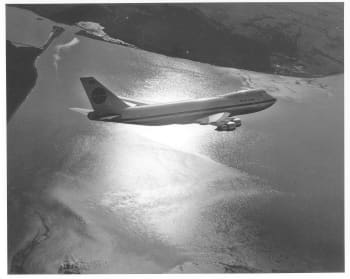
TRIPPE TO THE OVAL OFFICE
Images courtesy of The Lyndon B. Johnson Presidential Library
CONVINCING LBJ
On March 30, 1966, Trippe attended a White House dinner with other corporate leaders. He politely asked to cut into the reception line to pitch another meeting with LBJ, who told him to return in two days.
President Lyndon Johnson had been nervous about inflation and wanted corporate decision-makers to adopt austerity measures. A half-billion-dollar aircraft project wasn't going to sit well with LBJ, and Trippe perceived the situation deserved his personal touch.
THE MEETING
On April 1, Trippe returned prepared to be persuasive. The President gave him about 20 minutes in the Oval Office. Trippe explained the 747 was a great deal for America. It would employ thousands nationwide and boost the nation's balance of payments through sales to foreign airlines already expressing interest.
(Photos: Courtesy of the LBJ Presidential Library)
McNAMARA
LBJ was impressed but wanted Trippe to speak with Secretary of Defense Robert McNamara at the Pentagon. McNamara worried the 747 would fuel inflation alongside the recently announced two-billion-dollar Lockheed C-5A program for the Air Force.
McNamara questioned: Couldn’t the C-5A double as a civilian transport?
Trippe explained just how different the two aircraft were, and that one could not replace the other. McNamara accepted the argument and seconded the decision to support the Johnson Administration’s blessing for the 747.
Robert McNamara, Official Portrait by Oscar Porter, taken January 1961, released by the US Department of Defense (Wikimedia Commons).
Robert McNamara, Official Portrait by Oscar Porter, taken January 1961, released by the US Department of Defense (Wikimedia Commons).
MEETING SNAPSHOTS
Juan Trippe in the Oval Office with President Lyndon Johnson discussed benefiting the country and the US balance of payments, by building a widebody Boeing 747.
TWENTY FIVE 747's ORDERED
WITH MORE POSSIBLE
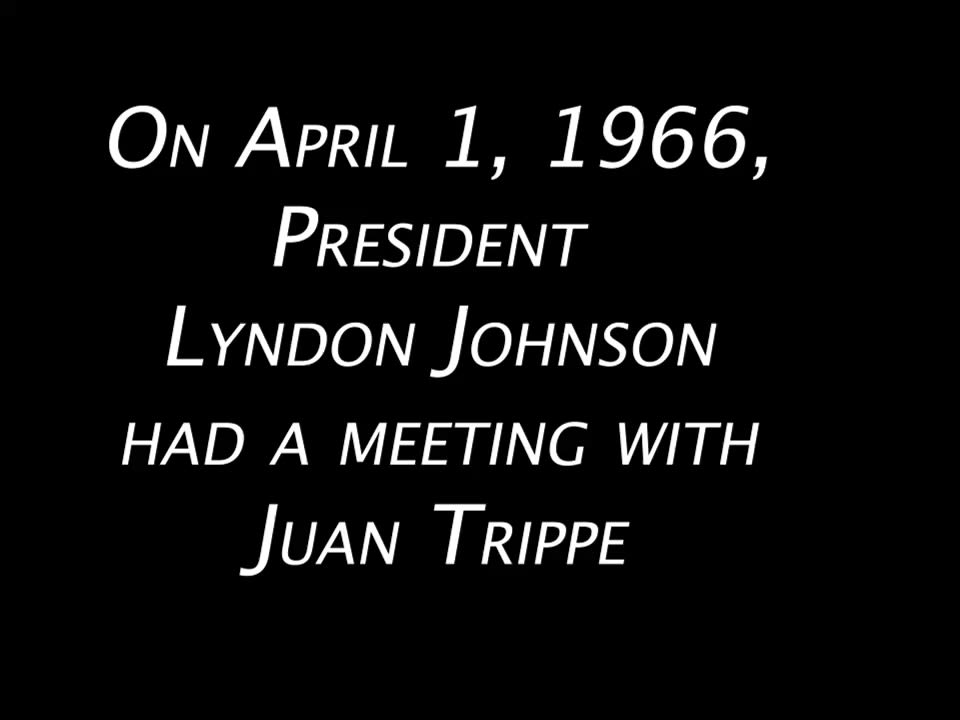
Less than two weeks later, the world learned that Pan Am & Boeing had signed a deal worth $525 million for the new jet.
Front page of Boeing News, April 14, 1966 (Courtesy Museum of Flight Archive).
Front page of Boeing News, April 14, 1966 (Courtesy Museum of Flight Archive).
Pan Am 747 Fuselage (Pan Am Historical Foundation Collection).
Pan Am 747 Fuselage (Pan Am Historical Foundation Collection).
EXPLORE MORE PAN AM HISTORY !
JOIN US !
 Built with Shorthand