
BIRTH
OF
THE SUPERJET
JUAN TRIPPE'S BOLD IDEAS
The state of commercial aviation in the 1960s was filled with boundless promise... and new challenges for industry planners.
Jets: Juan Trippe & The 1960s
Joe Sutter, Chief of the Boeing Superjet Design Team, delivered a speech in 2007 at the Wings Club in New York City.
Photos in Presentation
In 2007, Joe Sutter spoke on Juan Trippe's innovative ideas taking shape along with Boeing to develop the 747. (Wings Club Audio / Pan Am Historical Foundation Collection).
In 2007, Joe Sutter spoke on Juan Trippe's innovative ideas taking shape along with Boeing to develop the 747. (Wings Club Audio / Pan Am Historical Foundation Collection).
THE JOB AHEAD
Coordinating the effort and power behind the work of Boeing, Pan Am and Pratt & Whitney.
Juan Trippe's vision of a new jet to carry more passengers and cargo would be a challenge for the aircraft designers and manufacturers who took it on.
Not only that, the Superjet project demanded strong leaders with vast experience and commitment to get it launched.
December 1965: Pan Am signed a Letter of Intent signed with Boeing. For Juan Trippe, Bill Allen, Joe Sutter and scores of others, it would require:
• High-stakes decision-making.
• Building trust among collaborators.
• Coordinating the efforts of the best of Boeing, Pan Am and Pratt & Whitney.
Concept Illustration of a 747 lineup: The widebody approach to seating and cargo (Pan Am Historical Foundation Film Collection).
Concept Illustration of a 747 lineup: The widebody approach to seating and cargo (Pan Am Historical Foundation Film Collection).

Concept Illustration of a 747 lineup: The widebody approach to seating and cargo (Pan Am Historical Foundation Film Collection).
Concept Illustration of a 747 lineup: The widebody approach to seating and cargo (Pan Am Historical Foundation Film Collection).
Concept Illustration of a 747 lineup: The widebody approach to seating and cargo (Pan Am Historical Foundation Film Collection).
Concept Illustration of a 747 lineup: The widebody approach to seating and cargo (Pan Am Historical Foundation Film Collection).
THE JOB AHEAD
Coordinating the effort and power behind the work of Boeing, Pan Am and Pratt & Whitney.
Juan Trippe's vision of a new jet to carry more passengers and cargo would be a challenge for the aircraft designers and manufacturers who took it on.
Not only that, the Superjet project demanded strong leaders with vast experience and commitment to get it launched.
December 1965: Pan Am signed a Letter of Intent signed with Boeing. For Juan Trippe, Bill Allen, Joe Sutter and scores of others, it would require:
• High-stakes decision-making.
• Building trust among collaborators.
• Coordinating the efforts of the best of Boeing, Pan Am and Pratt & Whitney.
Concept Illustration of a 747 lineup: The widebody approach to seating and cargo (Pan Am Historical Foundation Film Collection).
Concept Illustration of a 747 lineup: The widebody approach to seating and cargo (Pan Am Historical Foundation Film Collection).
Concept Illustration of a 747 lineup: The widebody approach to seating and cargo (Pan Am Historical Foundation Film Collection).
Concept Illustration of a 747 lineup: The widebody approach to seating and cargo (Pan Am Historical Foundation Film Collection).
Concept Illustration of a 747 lineup: The widebody approach to seating and cargo (Pan Am Historical Foundation Film Collection).
Concept Illustration of a 747 lineup: The widebody approach to seating and cargo (Pan Am Historical Foundation Film Collection).
Comparing the 707 and 747: The picture tells the story of the new widebody approach to seating and cargo that would remove that "cramped" feeling on large jets with only one aisle (Frame, Pan Am Historical Foundation Film Collection).
Comparing the 707 and 747: The picture tells the story of the new widebody approach to seating and cargo that would remove that "cramped" feeling on large jets with only one aisle (Frame, Pan Am Historical Foundation Film Collection).
1958: IT BEGAN WITH THE JET AGE
A WAVE OF ENTHUSIASM
The actual advent of practical jet-powered transports began in 1958 with the Boeing 707 in the United States.
It unleashed a wave of air travel enthusiasm.
For passengers, jets cut travel times and maximized their dollars spent on vacation or business travel.
For airlines with long routes like Pan Am's there were decided advantages.
Pan Am Boeing 707 (Pan Am Historical Foundation Collection).
Pan Am Boeing 707 (Pan Am Historical Foundation Collection).
JETS & INCREASED PROFITABILITY
|
• PROFIT-EARNING FLIGHT HOURS OF EQUIPMENT. |
|
• SHORTER TURN-AROUND TIME. |
|
• MORE PAYING SEAT MILES EVERY YEAR. |
|
• ADVANCES IN MAINTENANCE EXPENSES. |
JET AGE STYLE & THE "JET SETTERS"
Passengers loved the new travel style with its ease and speed of trans-ocean travel to far-flung places.
The "Jet Set" became part of popular culture, making air travel glamorous and accessible.
It wasn’t such a stretch for average travelers to ‘join the club,’ taking flights on new jets to new destinations.
The Jet Set showed up in movies and TV, carving out a new niche in the popular imagination.
A WAVE OF ENTHUSIASM
The actual advent of practical jet-powered transports began in 1958 with the Boeing 707.
It unleashed a wave of air travel enthusiasm across the globe.
For passengers, jets cut travel times and maximized their dollars spent on vacation or business travel.
For airlines with long routes like Pan Am's there were decided advantages.
JETS & INCREASED PROFITABILITY
|
• PROFIT-EARNING FLIGHT HOURS OF EQUIPMENT. |
|
• SHORTER TURN-AROUND TIME. |
|
• MORE PAYING SEAT MILES EVERY YEAR. |
|
• ADVANCES IN MAINTENANCE EXPENSES. |
JET AGE STYLE & THE "JET SETTERS"
Passengers loved the new travel style with its ease and speed of trans-ocean travel to far-flung places.
The "Jet Set" became part of popular culture, making air travel glamorous and accessible.
It wasn’t such a stretch for average travelers to ‘join the club,’ taking flights on new jets to new destinations.
The Jet Set showed up in movies and TV, carving out a new niche in the popular imagination.
IT DIDN'T STOP THERE
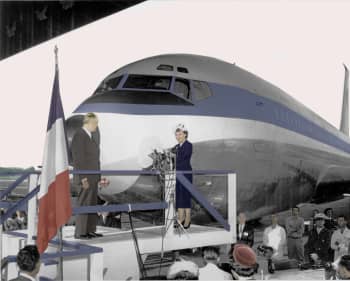
Pan Am 747 landing in London, 1970 (Pan Am Historical Foundation Film Collection).
Pan Am 747 landing in London, 1970 (Pan Am Historical Foundation Film Collection).
A BRAND NEW AIRCRAFT
Concepts of an exciting new airplane inspired tremendous energy and dedication among a multitude of workers who would build it in record time.
The Superjet was an idea that took root in the early 1960s during the expansive climate of the Jet Age.
It was developed by the ingenuity and the perseverance of thousands of people in Pan Am, The Boeing Company, and other participants in the aviation industry, including contractors that provided 65% of the components.
The Boeing 747 premiered in January 1970, the very first Superjet passenger flight departing from JFK International to London on Pan Am.
AND
IT WAS
A SENSATION!
The Superjet was a concept that took root in the early 1960s during the expansive climate of the Jet Age.
It was developed by the ingenuity and the perseverance of thousands of people in Pan Am, The Boeing Company, and other participants in the aviation industry, including contractors that provided 65% of the components.
The Boeing 747 premiered in January 1970, the very first Superjet passenger flight departing from JFK International to London on Pan Am.
AND
IT WAS
A SENSATION!
PAN AM'S
JET AGE DUO
Footage
"The once-huge 707 looked like a fighter beside the new giant."
-- Robert Blake, Pan Am Representative at Boeing.
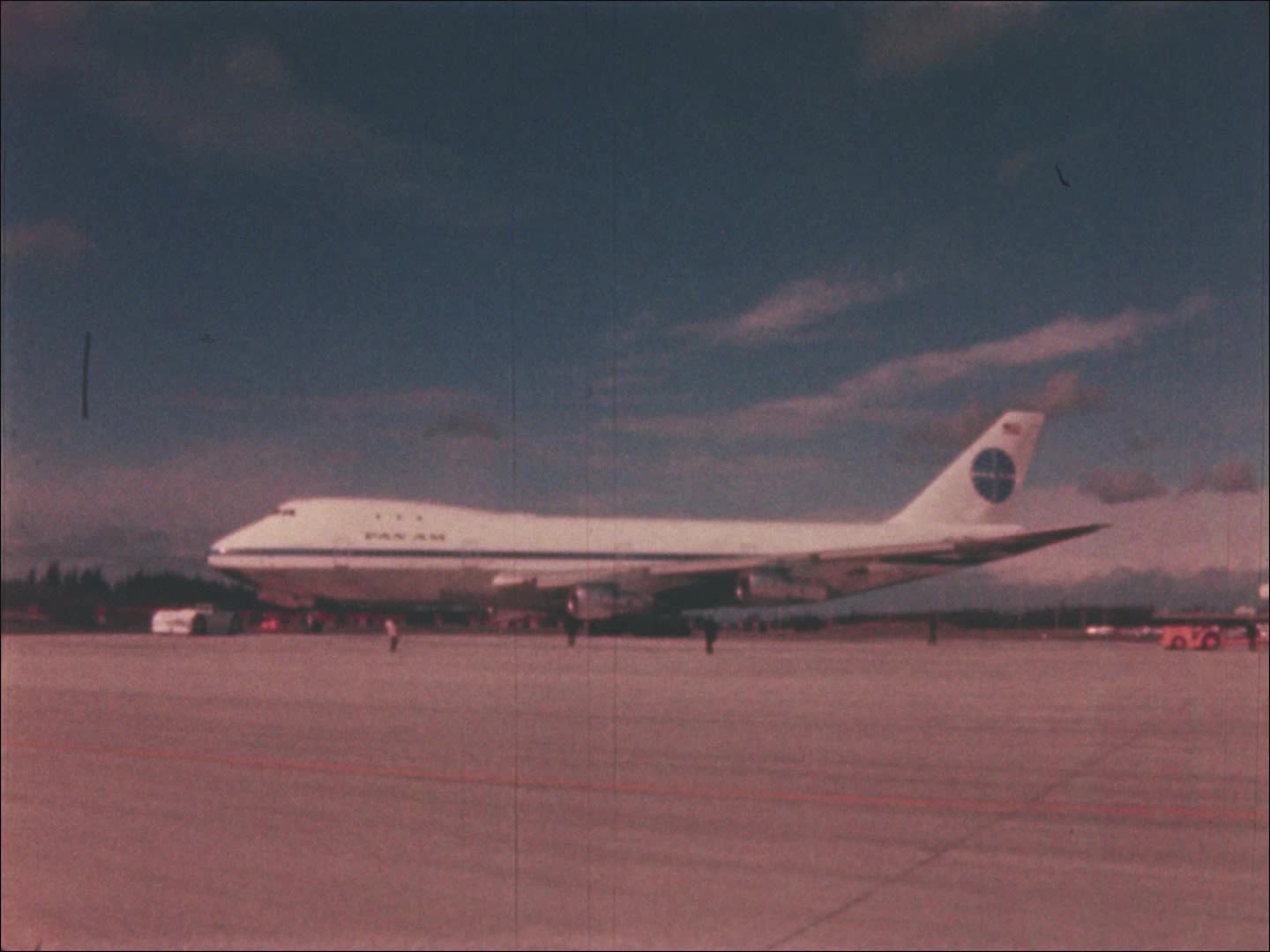
March 1969 at Boeing's Everett Factory, a Pan Am 747 and 707 were setting up for what would become an iconic size comparison shot. (Pan Am Historical Foundation Film Collection).
March 1969 at Boeing's Everett Factory, a Pan Am 747 and 707 were setting up for what would become an iconic size comparison shot. (Pan Am Historical Foundation Film Collection).
EXPLORE MORE PAN AM HISTORY !
JOIN US !
 Built with Shorthand