
1966
COMING
INTO
FOCUS
BY THE PAN AM HISTORICAL FOUNDATION
DREAMING BIG
AN ADDRESS BY PAN AM SENIOR VICE PRESIDENT
NAJEEB HALABY
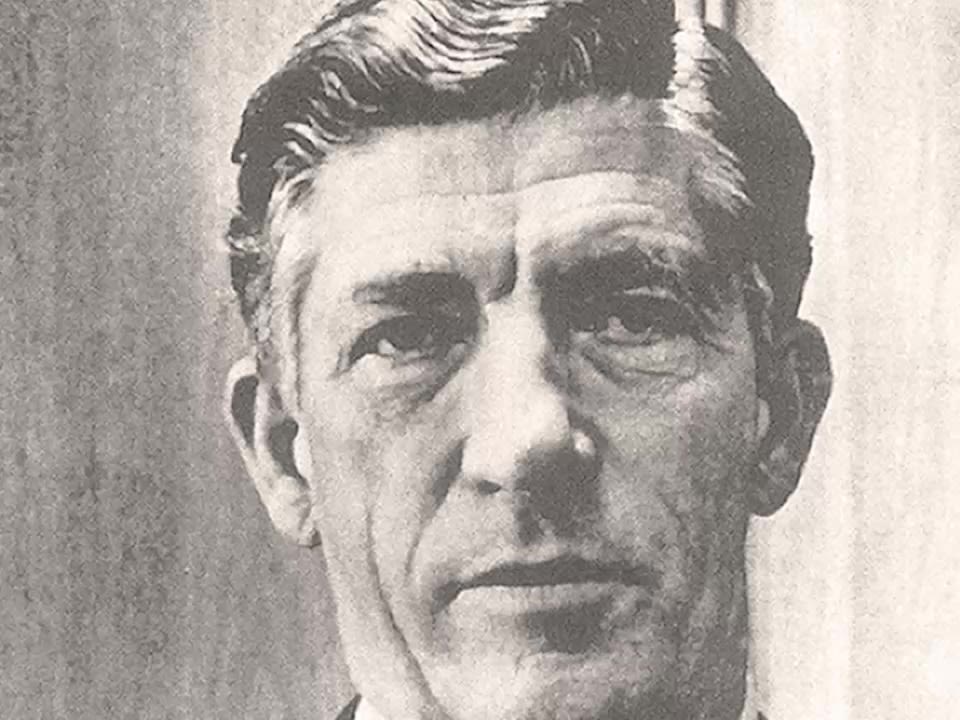
Voiced excerpt of Pan Am Sr. VP Najeeb Halaby's speech at Honolulu, October 1966 (Courtesy J. Walter Thompson Archive, Duke University Hartman Center).
Voiced excerpt of Pan Am Sr. VP Najeeb Halaby's speech at Honolulu, October 1966 (Courtesy J. Walter Thompson Archive, Duke University Hartman Center).
A GAMBLE
AND A CORPORATE DANCE
Aviation planners rightly saw the 747 as an evolutionary advance over the generation of 707 jets & DC-8's during the decade of the 1960s.
PAN AM SAW THE 747 AS THE PLANE FOR THE 1970s.
It would define the second stage of the Jet Era, an intermediate phase leading up to the inauguration of faster Supersonic Transports, or SSTs.
"... a number of three-way conferences ensued between Boeing, Pratt and Whitney and Pan American. How much weight could the new engines lift? How many people could a practical airframe contain? How many orders was Pan Am willing to guarantee? The shape and the size of the new airliner began to take form, and Boeing designated it the 747."
Robert Daley, "An American Saga: Juan Trippe and His Pan Am Empire," p.431.
JET AGE STAGE TWO
THE LETTER OF INTENT
December 1965. The Letter of Intent outlined that the new airplane would be able to operate from any airport that was currently served by 707-320B jets, or DC-8s.
It would profitably serve Pan Am's longest routes and deliver huge economies of scale for passenger and freight operations.
It would also cover projected capacity shortfalls and offer lower costs for flights, permitting lower fares for passengers.
This was the promise of the Superjet in December 1965:
· Have a range of 5,100 nautical miles
·Carry 354 passengers in mixed class, or 490 all economy seating
·Cruise at 45,000 ft. at .90 Mach
·Have a maximum take-off weight of 550,000 lbs. (i.e. the airplane with fuel & payload).
CRITICAL ELEMENTS
Delivering on that promise depended on the actual airplane’s weight, and the power of an engine that was still a proposal in its early stages. These two factors would become critical elements as the Superjet program progressed.
Boeing pledged to share a small percentage of profits with Pan Am after selling the first 150 aircraft, recognizing Pan Am's risks.
March 1st, 1966. The first two months of 1966 would let technical staffs hash out basic characteristics and detailed specifications, allowing Boeing to provide a firm price by the first of March.
Boeing then had five months to determine if there was a sufficient market to justify the project or cancel the deal.
If proceeding, Boeing would deliver two aircraft to Pan before FAA certification in Fall 1969 for training, then deliver the balance of the planes by summer 1970 to Pan Am.
EXPECTATIONS RUN INTO REALITIES
April 1966. Already by the actual purchase order signing in April 1966 for 23 passenger and two freighter variants, the performance specs had been whittled down.
One change became iconic: the spiral staircase and double-deck lounge above. Suggested by Pan Am and engineered by Boeing, it added 4,420 pounds and $200,000 to the price. Weight specs continued to go up. A year later, in March 1967, an empty 747's weight had increased by over 34,000 pounds.
With the expected arrival of SSTs in a few years, the subsonic 747 was meant for double duty as a passenger plane and freighter. Potential cargo-handling with straight-in nose loading made it sensible to have a nose that could be hinged and lifted with a flight deck placed above and out of the way.
Standardized 8x8 foot cargo containers would fit side-by-side, meaning the plane would need to be wide. Any notions of a tall fuselage were left on the drawing table.
"... graciousness to passengers was the by-product of the demand for eight-by-eight cargo containers two abreast.”
Laurence Kuter, "The Great Gamble," p. 19.
BIG RISKS ALL AROUND
Pan Am was committing to the largest ever aviation industry purchase, which would test the company at every level. The contract stipulated Boeing was entirely responsible to meet Pan Am's performance requirements.
The Boeing Company would have massive spending for plant, equipment, labor, and subcontractors—creating an entirely unprecedented airplane to be delivered on time. At the time of the contract signing, Boeing had delivered 700 jets to dozens of airlines, but the 747 would catapult the company into a new production dimension.
There was no time to waste.
September 1966. Boeing could back out of the deal if they failed to sell enough 747s by September, and pay a penalty. But the date came and went as other buyers began to express a great deal of interest in the new plane.
"The 1966 annual report was Trippe's pride and joy: a testimonial to one man's vision... In its thirty-ninth year, Pan Am showed an $83.7-million profit (up 60.7 percent from the year before on operating revenues of $841 million (up 25.7 percent)... More than two-thirds of the revenues were derived from carrying passengers over a 77,818-mile route system, the rest from cargo and mail. Not a cent was culled from government subsidy."
Marylin Bender and Selig Altschul,"The Chosen Instrument," p. 508.
FINANCIAL COMMITMENTS
PAN AM'S PAYMENTS
Pan Am's contract with Boeing called for installment payments, with half the total paid six months before first delivery of the 747—even before FAA airworthiness certification.
And those millions didn't include costs for spare engines, parts, or ground service equipment.
Also many millions more would need to be allocated to upgrade ground facilities at JFK and other Pan Am bases around the world for passengers, cargo and maintenance.
"Financial studies were conducted to measure future operating profits and sources of capital to finance the purchase of the new aircraft. This led to the conclusion that internally generated cash coupled with revolving credit, institutional credit, and a new issue of convertible subordinated debentures would be sufficient for the purpose at hand."
But the bottom line: if the new fleet didn't turn a profit, the company's future health would be severely strained—or worse.
BOEING'S RISKS
Boeing was committing vast sums - perhaps $2 billion, a substantial proportion of that as debt. The total value of the company at the time of the initial agreement with Pan Am was about $375 million.
If the project had failed to win enough customers, the result would have probably meant the end of the then-half-century-old company.
The up-front commitment to build the Everett plant alone was a massive undertaking.
Considering that the 747 was opening an entirely new market segment and depended on an engine that had yet to be produced, Bill Allen and his board were truly putting everything on the table.
"Pan Am was engaged in numerous economic evaluations of the proposed aircraft. Tentative route patterns were created and a 747 fleet "flown" over it in a computer simulation of the actual operation."
James A. Arey, "A Careful Decision."
THE SHAPE OF THINGS
Widebody
From Tube to Room
With its intended eventual cargo role, a brand new form factor came into play: the 747 would be a widebody aircraft.
With SSTs expected by 1975, it was believed that the 747 would be relegated to mostly freight operations.
Given that likelihood, there was wisdom in conforming to global shipping container standard dimensions of 8x8 feet. But loading containers side-by-side required a much wider fuselage than 707-style jets. It would, however, be easily converted to passenger or cargo use.
The plane’s design evolved from a double-decker to widebody configuration, and the change disrupted Juan Trippe's original vision of a tall airliner with double rows of windows.
As the story goes, Milt Heinemann, a Boeing payload engineer, went to New York with news about the new design. He met with Trippe and others in Pan Am’s board room bringing a 20-foot long clothesline, the width of the proposed cabin. Fortuitously, the room’s dimensions matched that of the passenger space.
Then and there the ideal for jet passenger cabins evolved from "tube" to "room." For passengers, a flight on a 747 would be like a holiday on their way to a holiday.
HIGH BY-PASS
The 747 program would become the first in American history where a totally new air frame was powered by a totally new engine — two brand new developments "meeting at the altar."
The 747 was being designed in an atmosphere of cooperation between three stakeholders. Pan Am, Boeing and Pratt & Whitney were taking existential risks. Both Pan Am and Boeing depended on the promised Pratt & Whitney turbofan engine, about which arrival date and promised performance were anything but certain.
There were a lot of unknowns in Pratt & Whitney's new JT9D engine — yet to be built.
However, according to Pan Am's Chief Engineer John Borger, P&W's proposed JT9D specs would allow as much as 30,000 lbs. greater payload at the same maximum takeoff weight as GE's competitor engine used on Lockheed C-5As!
With that knowledge, Boeing was responsible for the contractual engine agreement with Pratt & Whitney, while Pan Am depended on a successful outcome.
There was not much assurance for the first 747s flying with the first JT9Ds. It was the first time that P&W had designed an engine for a commercial airliner without a prior military order.
But the production JT9D model performance continued to improve. They produced greater thrust in successive iterations from 41,000 lbs to 45,000 lbs.
The brand new engine would make its appearance none too soon.
“This emerging technology was like money in the bank for my new airplane program. The imminent availability of such engines meant I could probably think as big as I liked and still have engines to power it.”
Joe Sutter, "747," p. 84.
MOCKUPS & TOURS
The very first order of business was to expand the 747 market and sell as many as possible to other airlines beyond Pan Am.
So, Boeing lost no time in creating models to entice buyers. By Spring 1966 potential customers were able to take tours of the 747's interior at Boeing's wooden mockup in their Renton plant.
Creating an interior mock-up introduced stakeholders to the proposed 747 concepts and dimensions. It provided a sense of scale and the experience of the twenty-foot-wide space compared to single-aisle jets. As time went by additional mockups were added, such as first class and upper deck spaces.
O 747 MOCKUP
WOODEN INTERIORS
747 Economy Class
HIGHER CEILINGS
& WIDER AISLES
Eight foot high ceilings and two extra-wide aisles are two interior features of the new Boeing 747. Pan American World Airways will carry 362 passengers -- 304 in Economy, and 58 in First Class. Economy seats on the Pan Am 747s are 34-inches wide and have armrests which can be raised and lowered."
-- Pan Am Press Release, 01/1970 (University of Miami Special Collections).
747 First Class Cabin
INTERIOR MOCKUPS
&
TOURS
Later when the planes were actually in service:
"Six galleys ... to serve upwards to 362 passengers. The double galley above, like the others, provides a walk-through capability from aisle to aisle."
-- Pan Am Press Release, 01/1970 (University of Miami Special Collections).
747 Upper Deck
SETUPS FOR THE
UPPER DECK
"A circular staircase... will connect the 747's main cabin with the flight deck...which may be converted into two private staterooms equipped with beds, made into separate offices or a lounge for first-class passengers. These spacious areas will afford people the opportunity to move around freely and help create the atmosphere of a club or salon, rather than a plane traveling just under the speed of sound."
--"Signature Magazine," (University of Miami Special Collections).
Early Boeing Mockup of 747 (Courtesy, AeroArt International).
Early Boeing Mockup of 747 (Courtesy, AeroArt International).
MORE
INTERIOR DESIGN IDEAS
Designers for the Boeing 747’s interior considered the 20 ft. x 190 ft. cabin a showcase of creativity with home‑like touches and new amenities added to it.
Ideas ranged from staterooms, bars, and nurseries on the upper deck to lounges, libraries, and even small theaters on the main level.
There was no limit to the possibilities — cabin sections could reflect unique style—from Danish Modern to French Provincial—and still incorporate practical comfort with swivel chairs and settees.
"Jet Lines," August, 1969 (Museum of Flight Archive).

By 1968, Pan Am's Annual Report showed a very sophisticated view of the plane's cabin.
747 mockups evolved as plans for the 747 interior were finalized.
747 Interior Mockup -- Passenger Seating (Courtesy AeroArt International Collection).
747 Interior Mockup -- Passenger Seating (Courtesy AeroArt International Collection).
When Juan Trippe and a top-level Pan Am group traveled to Seattle to review initial mock-ups, it just confirmed the superiority of the wide, single passenger deck design.
The cockpit area above the passenger deck had a long empty space behind it for aerodynamic efficiency. Trippe asked its purpose. Pan Am's Chief Engineer John Borger thought it would be a crew rest area, to which Trippe instinctively decided it should be for passengers!
Along with the iconic spiral staircase for between-deck access, the result was a game-changer for the 747 for the decades to come.
747 Mockup -- In-flight Service (Courtesy AeroArt International).
747 Mockup -- In-flight Service (Courtesy AeroArt International).
Boeing 747 Mockup: Seating arrangements tan & green (Courtesy AeroArt International Collection).
Boeing 747 Mockup: Seating arrangements tan & green (Courtesy AeroArt International Collection).
Boeing 747 Mockup: Upper Deck configuration with tables (Courtesy AeroArt International Collection).
Boeing 747 Mockup: Upper Deck configuration with tables (Courtesy AeroArt International Collection).
Boeing 747 Mockup: In-flight Service (Courtesy AeroArt International Collection).
Boeing 747 Mockup: In-flight Service (Courtesy AeroArt International Collection).
Boeing 747 Mockup: Upper Deck configuration (Courtesy AeroArt International Collection).
Boeing 747 Mockup: Upper Deck configuration (Courtesy AeroArt International Collection).
Boeing 747 Mockup: Seating arrangement red & tan (Courtesy AeroArt International Collection).
Boeing 747 Mockup: Seating arrangement red & tan (Courtesy AeroArt International Collection).
Boeing 747 Mockup: Seating arrangement tan & gold (Courtesy AeroArt International Collection).
Boeing 747 Mockup: Seating arrangement tan & gold (Courtesy AeroArt International Collection).
THE PROMISE OF THE SUPERJET
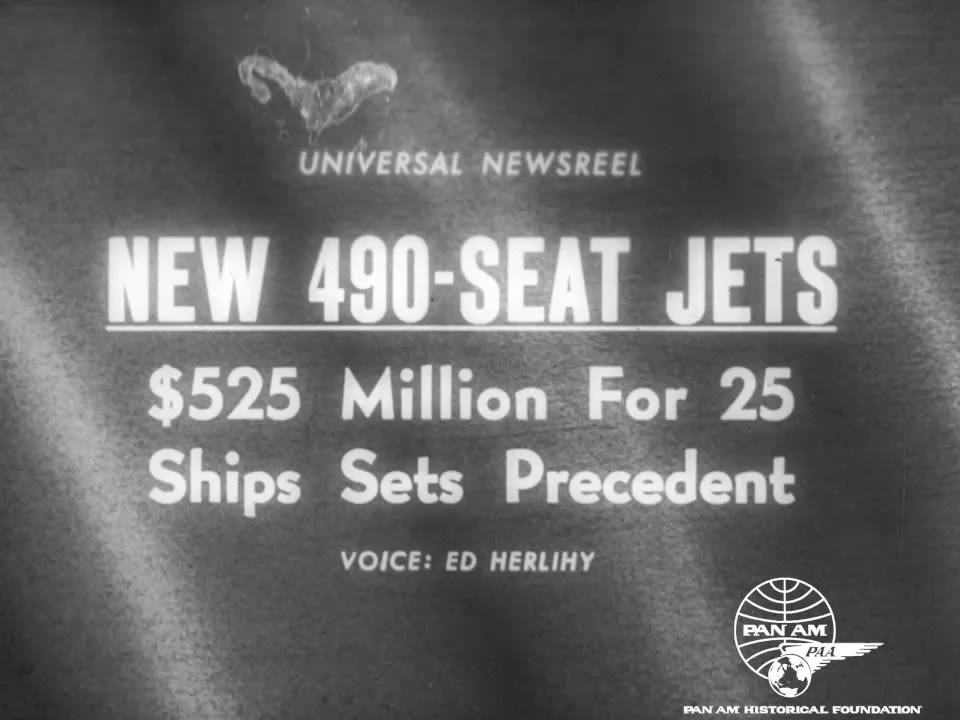
Universal Newsreel footage "New 490-Seat Jets" April 1966 (Courtesy National Archives Records Administration).
Universal Newsreel footage "New 490-Seat Jets" April 1966 (Courtesy National Archives Records Administration).
THE METAL MOCKUP AT RENTON
While a new 747 factory was still in its planning stages, a full-scale structural model built from metal would be constructed in buildings at Boeing's Renton plant, supervised by 747 chief engineer Joe Sutter and program manager Mal Stamper.
From 1966 to early 1967 during design reviews at Renton, airline executives and prospective 747 customers could experience the interior mockups when they visited and also tour the life size plane model.
The completion of the metal plane would eventually support engineering integration tests before flight hardware production, and later would serve as a full-size prototype for fitting systems and validating designs (without today’s digital tools).
"SHELL" MOVED TO EVERETT SITE
January 3, 1967. Responding to space constraints, Boeing had to make the decision to disassemble the 747 mockup and ship it in sections to a huge new factory then being constructed in Everett. Initially, production workers from manufacturing, quality control and finance arrived at Everett to reassemble the full scale model in a newly constructed mockup building, beginning their operations there.
Even as construction on the factory went on around them, their work on the model continued.
"Four hundred sixty employees moved into the site's first office building in February [1966]. That same month the manufacturing organization was host to more than 4300 people who attended the site's first open house."
-- Everett Flyer, July 1967 (Museum of Flight Archive).
The workers who persevered in the midst of construction of the huge plant were dubbed "The Incredibles," a name that eventually referred to all of the people who worked directly on the 747, due to the intense scheduling and excellence of their contributions.

THE METAL MOCKUP AT RENTON
While a new 747 factory was still in its planning stages, a full-scale structural model built from metal would be constructed in buildings at Boeing's Renton plant, supervised by 747 chief engineer Joe Sutter and program manager Mel Stamper.
From 1966 to early 1967 during design reviews at Renton, airline executives and prospective 747 customers could experience the interior mockups when they visited and also tour the life size plane model.
The completion of the metal plane would eventually support engineering integration tests before flight hardware production, and later would serve as a full-size prototype for fitting systems and validating designs (without today’s digital tools).
"SHELL" MOVED TO EVERETT SITE
January 3, 1967. Responding to space constraints, Boeing had to make the decision to disassemble the 747 mockup and ship it in sections to a huge new factory then being constructed in Everett. Initially, production workers from manufacturing, quality control and finance arrived at Everett to reassemble the full scale model in a newly constructed mockup building, beginning their operations there.
Even as construction on the factory went on around them, their work on the model continued.
The workers who persevered in the midst of construction of the huge plant were dubbed "The Incredibles," a name that eventually referred to all of the people who worked directly on the 747, due to the intense scheduling and excellence of their contributions.
Cover of "Boeing Magazine" shows plane mockup, August 1967 (Museum of Flight Archives).
Cover of "Boeing Magazine" shows plane mockup, August 1967 (Museum of Flight Archives).
MEETING THE GIANT
Bob Blake, who worked for Pan Am's Dassault Falcon program in France, was transferred to the Boeing plant in July of 1967 to monitor the 747 program on behalf of Pan Am. Here's a humorous account of his first impressions of the plane.
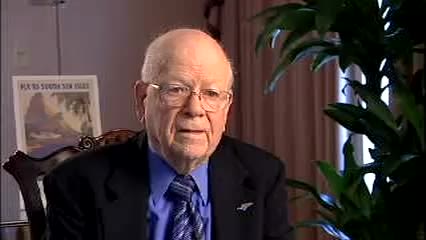
Bob Blake, Pan Am representative at Boeing, talks about seeing the 747 for the first time in 1967. (From an interview in 2005 by Pelican Films).
Bob Blake, Pan Am representative at Boeing, talks about seeing the 747 for the first time in 1967. (From an interview in 2005 by Pelican Films).
From the time the Letter of Intent was signed (Dec.22, 1965) until the official contract signing (Apr. 13th, 1966), Pan Am and Boeing staffs sparred over specifications defining the 747 design.
The plane's weight grew, potential performance suffered, and profits looked to be shrinking. But...
Undaunted, Boeing and Pan Am forged ahead to work out their design challenges.
EXPLORE MORE PAN AM HISTORY !
JOIN US !
 Built with Shorthand