
1965
A GOOD PROBLEM TO HAVE
By 1965 commercial aviation was
celebrating a half-century of passenger service.
WHAT WAS NEXT?
JUAN TRIPPE LOOKS AHEAD
THE TONY JANUS AWARDS
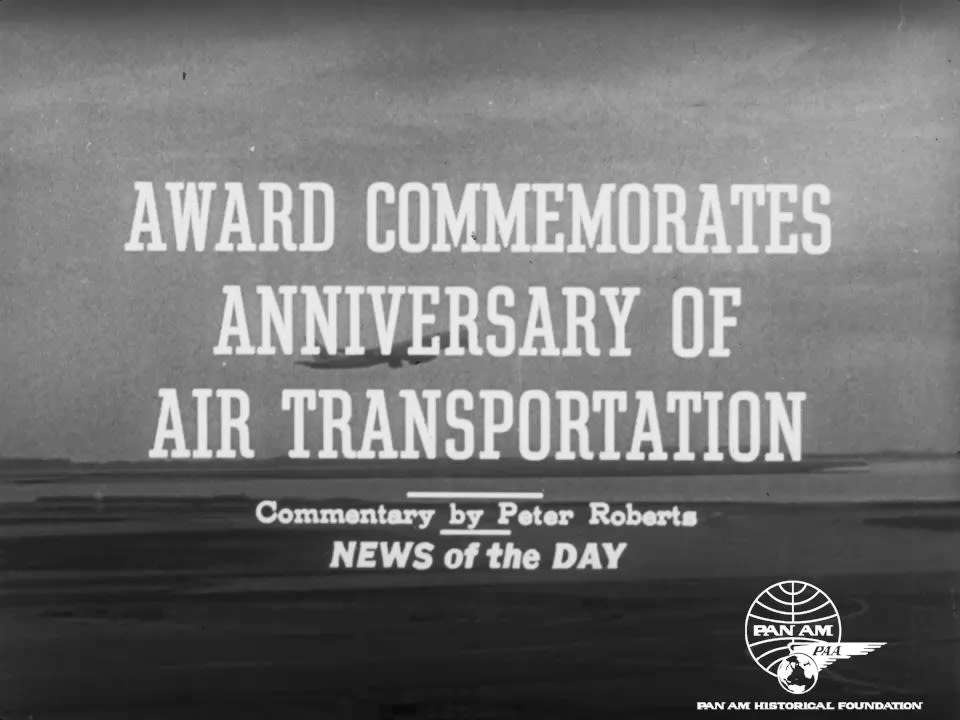
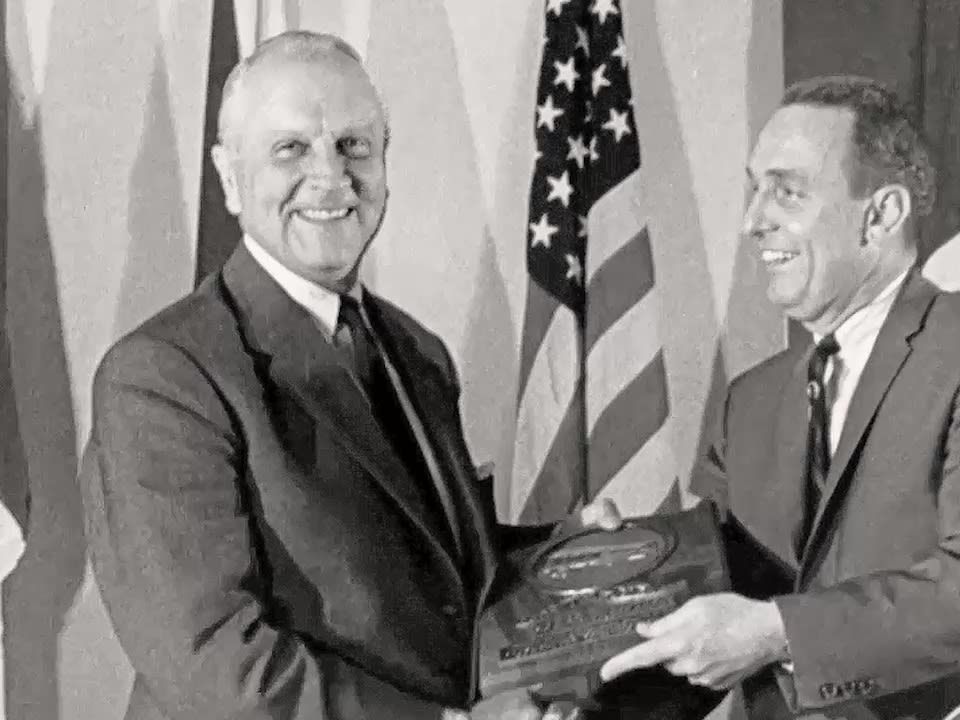
Hearst's "News of the Day" newsreel covered the Tony Janus 51st Anniversary celebration in March 1965 with an award to Juan Trippe (Pan Am Historical Foundation Film Collection).
Hearst's "News of the Day" newsreel covered the Tony Janus 51st Anniversary celebration in March 1965 with an award to Juan Trippe (Pan Am Historical Foundation Film Collection).
OPPORTUNITIES
CAME WITH DEMANDS
More Capacity - More Investment - More Technology
Estimates for growth over the next decade ranged upward from 70%, with annual growth predicted to exceed 13%. For industry planners, what was needed was more. Capacity, investment, and technology were at the top of the agenda for new aviation strategies.
The most glamorous vision was the Supersonic Transport—the SST. Europeans had started developing the Concorde, and President Kennedy had put an American SST on the national agenda in 1962.
The SST was on Juan Trippe’s mind when he spoke in Tampa
Voiced excerpt from Juan Trippe's acceptance speech on receiving the Tony Janus Award, March 1965 (From Speeches by Pan Am Executives University of Miami Special Collections).
Voiced excerpt from Juan Trippe's acceptance speech on receiving the Tony Janus Award, March 1965 (From Speeches by Pan Am Executives University of Miami Special Collections).
"The 747 will be an extraordinary aircraft..." From The Jet Age/Second Stage: The 747 Superjet System. Pan American World Airways publication, 1967 (University of Miami Special Collections).
"The 747 will be an extraordinary aircraft..." From The Jet Age/Second Stage: The 747 Superjet System. Pan American World Airways publication, 1967 (University of Miami Special Collections).
Pan Am Concept of SSTs of the Future, Pan Am 1967 Annual Report (University of Miami Special Collections, Pan American World Airways, Inc. records).
Pan Am Concept of SSTs of the Future, Pan Am 1967 Annual Report (University of Miami Special Collections, Pan American World Airways, Inc. records).
During a two-day tour of the Boeing facilities and 747 and SST mockups, writers for news and trade publications got updated on the status of the subsonic 747 and supersonic B2707.
"The SST and the 747 will not be in competition... but there is an interrelationship and the two aircraft will complement each other... A common ground for the two airplanes will be their major contribution to international trade and a favorable balance of payments."
-- John O. Yeasting VP-General Manager, Commercial Airplane Division. "Boeing News," September 29, 1966.
Concept illustration of a Boeing 747 and Boeing SST parked at a terminal (Photo: James Vaughn/Xray-Delta 0ne on Flickr).
TRIPPE'S NEW HORIZONS
Along with uncertainty came optimism
In 1965, America was imbued with a sense of possibilities and opportunities. For aviation, however, there remained nagging questions about market segmentation, and strained capacity of overcrowded airspace and airports.
Pan Am's Juan Trippe with TWA Chairman Charles Tillinghast, shakes hands on proposed Pan Am-TWA merger, 1963 (Pan Am Historical Foundation Collection).
Pan Am's Juan Trippe with TWA Chairman Charles Tillinghast, shakes hands on proposed Pan Am-TWA merger, 1963 (Pan Am Historical Foundation Collection).
After a proposed merger between Pan Am & TWA didn't transpire, Pan Am's leader, Juan Terry Trippe, failing to obtain new domestic routes, turned to a more far-reaching strategy.
Back in 1955 his paradigm-shifting decision to buy dozens of jets had sent shock waves through the industry. Now, a decade later, he still dreamed of new horizons.
Trippe had remained a visionary, even as he approached retirement. His internal compass always pointed to enhancing aviation technology, leading to better operating economics, and more profits.
He envisioned a Pan Am fleet that would fly faster, with more passengers and payload. This would ease airspace congestion and lower costs—opening the door to lower fares and increased traffic.
1960s passengers at the airport terminal showing crowded TWA ticket counter and Eastern Air Lines DC-7 (Wikimedia Commons: FAA photo).
1960s passengers at the airport terminal showing crowded TWA ticket counter and Eastern Air Lines DC-7 (Wikimedia Commons: FAA photo).
Bottom Line for Juan Trippe
Pan Am needed bigger and faster aircraft. While the American SST program's future remained uncertain, and depended on government subsidies, Pan Am could keep its options open.
VYING FOR THE USAF C5-A CONTRACT
By early 1965, Boeing, Lockheed, and Douglas all had bids pending with the US Air Force to develop the huge new C-5A military cargo plane. A commercial version might serve as a civilian aircraft.
But September 30th 1965 was the pivotal date in the 747 story. That day, Pan Am's Frank Gledhill was in California prepared to sign with Douglas Aircraft for preliminary work on a new big jet when the C-5A contract award to Lockheed was announced.
That ended Pan Am's discussions with Douglas.
Later, LBJ attended the C-5A's Rollout in 1968 at Lockheed-Georgia. Photo from “The Chronological History of the C-5 Galaxy” by Leland & Wilcoxson, p. 6, (2004 - US Air Force, Office of History, Air Mobility Command).
Later, LBJ attended the C-5A's Rollout in 1968 at Lockheed-Georgia. Photo from “The Chronological History of the C-5 Galaxy” by Leland & Wilcoxson, p. 6, (2004 - US Air Force, Office of History, Air Mobility Command).
Within minutes, Juan Trippe called Lockheed CEO Courtland Gross about a civilian version of the C-5A.
Gross said he would call Trippe back.
But Lockheed would struggle with the C-5A’s development.
TRIPPE WOULDN'T NEED THAT CALL
He'd already moved on.
A MEETING
OF
MINDS
On the steps of the new B-747: Boeing's Bill Allen with Juan Trippe 1969 (Pan Am Historical Foundation Collection).
On the steps of the new B-747: Boeing's Bill Allen with Juan Trippe 1969 (Pan Am Historical Foundation Collection).
For years, Juan Trippe had taken annual fishing trips with his friend Bill Allen, CEO of Boeing. Both men were the same age. They could relate to each other as peers. Both ran important companies that had succeeded by balancing challenges with opportunities. On such a trip in August 1965 in Alaska, the two friends put their heads together.
Pan Am was doing well but constrained by operational and competitive pressures, including European airlines flying with government subsidies.
Boeing's situation seemed clouded after losing the C-5A contract. They had other commitments—helicopters for the military, orders for 727s, NASA's Space Program needs, and the new 737 on drawing boards. Plus, Boeing was a strong SST contender with ideas for building the B-2707.
The Boeing Company was stretched.
But when Juan Trippe challenged Bill Allen about building the world's largest civilian airplane, Allen could see the potential.
Famously, the two came to an understanding: "If you build it, I'll buy it!" said Trippe. "If you buy it, I'll build it," said Allen.

BOEING'S PROJECTS
OF THE 1960s
B-727 / B-737 / B-2707 / Helicopters
B-727 illustration by Mike Machat (From R.E.G. Davies. "Pan Am: An Airline and its Aircraft").
B-727 illustration by Mike Machat (From R.E.G. Davies. "Pan Am: An Airline and its Aircraft").
B-737 illustration by Mike Machat (From R.E.G. Davies. "Pan Am: An Airline and its Aircraft").
B-737 illustration by Mike Machat (From R.E.G. Davies. "Pan Am: An Airline and its Aircraft").
Concept illustration of a Boeing SST (US National Archives and Records Administration/NASA).
Concept illustration of a Boeing SST (US National Archives and Records Administration/NASA).
In 1966 Boeing's Helicoptor Division opened a new facility outside Philadelphia to manufacture helicopters for the US armed forces. (Photo: New York Airways Boeing Vertol helicopter flew passengers to and from the top of the Pan Am Building to New York City area airports, c. 1966. Pan Am Historical Foundation Collection).
In 1966 Boeing's Helicoptor Division opened a new facility outside Philadelphia to manufacture helicopters for the US armed forces. (Photo: New York Airways Boeing Vertol helicopter flew passengers to and from the top of the Pan Am Building to New York City area airports, c. 1966. Pan Am Historical Foundation Collection).
B-727 illustration by Mike Machat (From R.E.G. Davies. "Pan Am: An Airline and its Aircraft").
B-727 illustration by Mike Machat (From R.E.G. Davies. "Pan Am: An Airline and its Aircraft").
B-737 illustrations by Mike Machat (From R.E.G. Davies. "Pan Am: An Airline and its Aircraft").
B-737 illustrations by Mike Machat (From R.E.G. Davies. "Pan Am: An Airline and its Aircraft").
Concept illustration of a Boeing SST (US National Archives and Records Administration/NASA).
Concept illustration of a Boeing SST (US National Archives and Records Administration/NASA).
In 1966 Boeing's Helicoptor Division opened a new facility outside Philadelphia to manufacture helicopters for the US armed forces. (Photo: New York Airways Boeing Vertol helicopter flew passengers to and from the Pan Am Building to New York City area airports, c. 1966. Pan Am Historical Foundation Collection).
In 1966 Boeing's Helicoptor Division opened a new facility outside Philadelphia to manufacture helicopters for the US armed forces. (Photo: New York Airways Boeing Vertol helicopter flew passengers to and from the Pan Am Building to New York City area airports, c. 1966. Pan Am Historical Foundation Collection).
EXPLORE MORE PAN AM HISTORY !
JOIN US !
 Built with Shorthand